Showing posts with label Bible. Show all posts

Friday, September 4, 2020

Finding Hidden Treasure


 One of our a Bible studies for this year is Hidden Treasures in Philippians.  We are working double-speed through this study so we can begin Hidden Treasures in Hebrews after Christmas.

Heart of Dakota has “Bible” as an independent subject at this level.  However, I am doing the subject with my daughter.  I want her to learn to have personal Bible time, but I also think discipleship is not a solitary practice.  


Discipleship is a beautiful thing.  The discussions that happen during Bible time are priceless.  For instance, today we were reading about 2 Corinthians 6:14. 


“Do not be bound together with unbelievers; for what partnership have righteousness and lawlessness, or what fellowship has light with darkness?”

‭‭2 Corinthians‬ ‭6:14 NASB 


We talked about how being bound means having a close relationship.  We are bound when we marry.  We are also bound by our friends.  The discussion centered around choosing Godly friendships, or ones in which we choose friends that also love Jesus.  

This doesn’t mean we can never befriend someone that isn’t a Christian.  It does mean that we must be careful in our friendships; that our closest friends share our faith.    I gave the example of how it is easier to pull a person off of a chair than the person on the chair to lift up someone from the ground.  

These discussions are important to me because, as much as I want my child to remember the lessons in the Bible study, she will remember the conversations and the practical applications of the Scriptures just as much. 


“Iron sharpens iron, So one man sharpens another.”

‭‭Proverbs‬ ‭27:17‬ ‭NASB‬‬


I look at Bible study at this crucial age as iron sharpening iron.  She does study her Bible for other things, such as challenges given in her youth group.  With Heart of Dakota, she is in her Bible daily to look up what it says about different topics she is covering in history or science.  

Right now my husband and I are beginning ministry classes.  We find doing them together or with a group gives us much more than just doing the classes alone.  We still have private time with God in the Word and prayer time.  However, doing the classes with others gives is the chance to trade ideas and discuss meanings. 

My favorite memories with my older homeschooled children were the Bible times we had in the mornings.  It was not a mostly serious time.  It was light-hearted and fun.  My girls would sing Veggietales songs, even into high school, when we got to a particular lesson that was related to a Veggietales movie.   They also had a blast trying to pronounce some of the Old Testament names.  This time has become part of our family culture, as the stories still are brought up during family gatherings. 

Is there anything better than having Bible study as a part of your family culture?

Our mornings start with the Word of God.  I love the name of this inductive study...  Hidden Treasures.  That is exactly what I feel like we are doing, digging for Treasure.  

I worried that this study might be a little too young for my daughter.  Instead, I have found we can always go a little deeper during our conversations.  Today, for instance, when we discussing being “bound” to friends, we actually talked about various friends of hers and mine.  This wasn’t a judgment on any of them, but more a conversation about which friends bring out the best side of us, encouraging us in our faith and our daily walk.  It was also a reminder of the type of friend we need to be to others.

Best of all, it was a reminder that Jesus is our best friend; always there to encourage, support, listen, and guide.  He will always be honest.  He will always correct us when we are wrong.  Most of all, He will always love us. 


Tuesday, August 11, 2020

Bible Studies in Homeschooling


We normally use something else for Bible.  (I have loved CLE Bible for years.) This school year I decided to add in what Heart of Dakota schedules and just do both.  Why?  

Both programs are excellent.  They have a very different focus. CLE Bible is a great way to learn the chronology of the Bible and study the major themes carefully.  It takes a student through the Old Testament and then the New Testament at least a couple times.  It’s a slow walk through the Bible that cycles back around with increasing detail and skills as the child matures.  

Heart of Dakota goes through the Bible during Creation to Christ. However, then it doesn’t do so again until high school.  Instead, it takes books of the Bible and studies them more in-depth.  For instance, Preparing Hearts studies Psalms; Resurrection to Reformation studies Philippians; and Revival to Revolution studies Hebrews; etc.   Many of these are inductive studies that teach the student how to dig deeper into the Bible and apply what they learn to their lives. 

I love the idea of both.  I also love that Heart of Dakota’s program teaches children to have their own personal Bible time and incorporates music quite often.  

I hesitated to add more to my child’s day, and am very selective.  She does do some extra reading.  She also takes piano lessons once a week.  I felt that being thoroughly grounded in the Word was vital.  It’s an addition we both enjoy.

We work through both programs together.  Both could be done independently.  There have been seasons when doing the work independently was important.  Right now, however, I feel that doing the work together leads to very important discussions.  

Will we always do all the work together for Bible or so two programs?  We won’t always do two programs.  I’ll make a decision in high school which program I want to do.  There will be no need to do two Old or New Testament survey classes.  We might always do them together.  I did Bible with my older girls until graduation and it was amazing. 


Wednesday, August 5, 2020

A Tale of Two Levels: Part One


Eighth grade is upon us.  Since we did some other things last year, we could say we are “behind.”  But most homeschoolers know there is no “behind.”  The time away from Heart of Dakota was still filled with learning.  The beauty about Heart of Dakota is that the skills build on each other.  We can just pick up where we were and move forward as long as the child hasn’t progressed too far.  

So a few weeks ago we began eighth grade with half days because Covid had led to the cancellation of nearly every activity in which we normally participate.  Not willing to have a summer of YouTube videos, we began some school.  We picked up right where we left off and have kept moving forward.

However, we are over halfway through Heart of Dakota’s Resurrection to Reformation guide.  This means we will actually do two guides this year.  Megan will finish up Resurrection to Reformation by Christmas.  We will immediately begin Revival to Revolution. 

Part One: Resurrection to Reformation


I’ll go through the first part of our school year by going through Resurrection to Reformation and other things we are using.   There are a LOT of books my daughter will be reading.  That isn’t unusual for our homeschool.  

History:

With Mystery of History as the main spine for the remainder of the guide. Megan will be reading about Shakespeare, Leonardo da Vinci, Sir Walter Raleigh and so much more.  She will read and notebook her way through time as she learns history. 


I love the notebooking pages!  They are colorful and of great quality.  The lessons are so enhanced by the pages!  And it is such a fun way to keep track of what my daughter has learned. 

Science:

My daughter loves Earth Science, so finishing up this study is a joy for her.  She is relishing the experiments and often loves to tell me all about what she is reading. 


Resurrection To Reformation does a Shakespeare study.  I was afraid this study would be difficult for my child.  Instead, she LOVES it!  She gets excited when it is Shakespeare day.  Like the history notebooking pages, Heart of Dakota has created these beautiful Shakespeare notebooking pages. And they chose Charles and Mary Lamb’s Tales from Shakespeare.  Tales from Shakespeare is written in more modern English for younger readers. 

Bible:

Heart of Dakota’s Resurrection to Reformation uses the inductive Bible study Hidden Treasures in Philippians.  This is scheduled as an independent study to help the child develop good habits in their own personal Bible time with God.  However, I am planning to do this with my daughter.  She is at a sensitive age, and being able to discuss the study with her is important to me.  (Plus, I don’t want to miss out!)

We also have a different Bible study we do every other day or so from Christian Light Education.  I love how deep Christian Light goes into the Bible.  


Reading:


We are continuing with Heart of Dakota’s Drawn Into the Heart of Reading.  I love the perks of this program! I can choose which books to use for the different genres.  I can use library books to save money.  Or, as I tend to do, I can use books I have already purchased over time.  I like the choices Heart of Dakota gives in their book packs, and have used them often also.  But sometimes I switch out the book for something else. 

Extra Reading:

I chose two book series to slowly have Megan read through over the next two years.  These aren’t assigned in Heart of Dakota, but instead are something extra I want my daughter to experience.  She is reading them slowly so she can mature a bit with the characters as they age in the books.  I also want her to savor the books and think about the lessons contained.

The first series is a rewrite of Martha Finley’s Elsie Dinsmore series.  I read them all several years ago from the library.  Mission City Press did such a great job with these books and I am sad they aren’t as easily purchased now.  I still have the last two to purchase before we own the entire set.  Megan will read through at least three of the books this year. 


The second series is the Terrestria Series by Ed Dunlop.  I was first introduced to the series through Heart of Dakota when they offered a couple of the selections in the book packs for Drawn Into the Heart of Reading.  The books are allegorical and engaging.  My daughter often likes fantasy books, and these are very godly.  It will take her two years to get through this entire series when alternated with Elsie Dinsmore.  . 


What’s left?

In the next post I will go through what we are using for Revival to Revolution as well as what we use for math and any alternatives I am using.  It looks to be a very full year!


Saturday, October 20, 2018

Weekly Update - October 15-19

We had a four day week, and it was a bit stressed.  I got sick and struggled each day to function.  School happened, but I had limited participation due to illness.  On Friday, we skipped school entirely so I could pick up my glasses from the eye doctor, which is an hour away from our home.  But, we had a good time hanging out at Barnes and Nobles for an hour or so.


History:

Megan continued to study Adoniram Judson.  She also learned some of the history of Robert Fulton and his steamboat.  She learned about Myanmar; the climate, geography, natural resources, and the culture.  She will finish her study of Adoniram Judson next week.

Bible:

Megan read about the Poetry and Wisdom books as well as the Prophets in the Old Testament.  She learned about Psalms, Proverbs, Ecclesiastes, Song of Songs, and Job.  She read a bit about Amos. 

McGuffey:

Megan finished the story "More Stories about Little Birds."  She did a lot of copywork and drew pictures of various birds.  She began "Spring, Summer, Autumn, and Winter."

Literature:

Megan began reading the book Miracle at Camp Friendship, reading the first three chapters.   She is learning about point of view in her literature study, such as first person and third person.  She also played an alphabet game where she had to come up with a word for each letter of the alphabet having to do with a topic.  She thought that was a fun activity.

She is still reading When Will This Cruel War Be Over. 

 Word Building:

Megan continued to study "ge," and "dge," words as well as the days of the week.  She also began some plural word spellings, which include words where the spelling changes when it is plural. 

Science:

Science has been relegated to every other day.  This week Megan was learning about Celcius and Fahrenheit.  She also read about how gravity impacts the weight of things.

English:

Megan finished learning about different sentence types and alphabetizing.  This next weeks she will move on to reviewing and learning new skills in nouns.

Math:

I realized I forgot to update Math last week.  Megan has made a lot of progress in her math.  She has been reviewing fractions and ordinal numbers.  She has also been practicing her long division and is doing very well.  The constant review in Ace Math helps her to solidify her skills.  I am proud of her progress.  She will be introduced to some new skills in the coming weeks, and I am certain she is ready now.  She also conquered another couple chapters in Life of Fred Honey. 

Read Aloud:

We are continuing to read Anne of Green Gables in the mornings.  We read four chapters, which was pretty good considering my cold limited my ability to read aloud.  


Monday, October 15, 2018

Weekly Update - Crazy Week - October 8-12

School did not happen as normal last week.  And, I am perfectly fine with that reality.  My second grandson was born on Wednesday.

He was in the NICU for a couple of days, fighting low blood sugars because his mom is a type-one diabetic.  So, there was a lot of time spent up at the hospital.

Then, on Friday, we skipped school completely for eye exam day.  This year my little bookworm-in-training needed glasses.  We had avoided them last year, as she was borderline then, but this year the doctor felt that her near-sightedness was getting bad enough that she could use them.  If she was in school, she would have probably struggled to see the board or Power Points.  At home, she does a lot of reading, but she isn't straining her eyes to see, and that might have helped.


With school happening only sporadically, I did make a decision.  I changed up our routine a bit, because Megan seemed to be getting dragged down.  I noticed she had skipped some work, and I don't want her doing that in a rush to get through her day.

History:

Megan is taking a break from World History to study Adoniram Judson and Myanmar.  She is also learning a bit about ships in her lessons.  I find it interesting that a young Adoniram Judson was not a Christian despite growing up in a home where his father was a minister.  This delved into studies about Lazarus and the Rich Man as well as The Prodigal Son.    A break from normal studies seems to help Megan to refocus later. 

Bible:

In her New Testament study, Megan continued to learn about Paul's Letters to Phillip and Thessalonica.  She also read Daniel 10 and part of Daniel 11. 

McGuffey:

In McGuffey, Megan finished up "Stories about Birds" and worked on "More Stories about Birds."  Above is her drawing of a canary.

Literature:

Megan is learning about synonyms and antonyms as she prepares to start Miracle at Camp Friendship.  She is still reading When Will This Cruel War be Over for her independent reading.

Word Building:

We are taking a break from dictation for a few weeks and delving into some Word Building.  Megan and I love dictation, but variety sometimes helps.  Word Building deals with more than just spelling, but adds in some vocabulary and handwriting practice. It also helps to reinforce words through repetition and word groups.  Last week she studied words that has the "o" before "r" sound, such as storm and forty.  This week she is reviewing "dge" words as well as the days of the week.  It's not her favorite, but she can work independently.

Science:

In science, we paused Megan's study of birds to focus on learning about length, weight, temperature, and time.  We will go back to birds when she finishes this study.  Doing two different studies at one time was getting confusing. 

English:

We set aside the Language Lessons briefly to study dictionary skills and alphabetical order.  I realized a couple weeks ago that Megan had not gotten much practical use in using a dictionary for awhile because we were using dictionary.com too often.  It's easy to rely on technology and not use real books.  Because of this, I made the switch and Megan is refreshing skills she hasn't used for awhile.

Read Aloud:

We are loving Anne of Green Gables.  We didn't get as much read aloud time in last week as we would have liked.  We stopped at chapter nine.  But Anne and Megan are quite similar in temperaments and chattiness. 


Sunday, September 23, 2018

Weekly Check-Up: September 17-21


It was a busy week, with experiments and drawing and a lot of reading.  We even had a cool experience in meeting a local children's author!

On Thursday evening we went to our local library and got to meet Shannon Anderson, a local teacher and author.  Megan thought meeting an actual author was cool, even if her books are for a younger target audience.  We love books, so it is cool to meet someone published!

We got a lot done this week, even with a couple days where we were delayed in getting started.

History:

Megan began learning about Jonah and Ninevah.  She began to delve into Babylon, Jeremiah's prophecies, and Nebuchadnezzar.  She read the book of Jonah in the Bible and is continuing in the book, Within the Palace Gates, which is a story about Nehemiah.

Bible:

In Bible, Megan read about Ninevah and Judah.  In New Testament, Megan learned more about Paul's letter to Colosse.

Science:

Megan worked on her science experiment, which included soaking a raw egg in vinegar for three days.  She is currently soaking that same egg in Corn Syrup for an additional three days.  This is teaching her about eggs and how baby birds survive and grow before hatching.  She also began studying baby pigeons and sketched some local birds.

Poetry:

This week, Megan studied Robert Frost's poem, Dust of the Snow, and began to paint a snowy landscape.

McGuffey:

In McGuffey, Megan read and learned about turtles, writing facts about turtles and sketching one in her notebook.  She then began reading a story called "The Quarrelsome Roosters."

Language Lessons:

Megan reviewed subjects and predicates as well as complete and incomplete sentences.

Literature:

Megan finished reading My Father's Dragon.  She then began to read The Bridge.  She also learned about the character traits Love, Compassion, and Tolerance.  She touched on emotions displayed in My Father's Dragon.  When she began The Bridge, she studied the setting and began to evaluate the moods displayed in the book.  In her independent reading, she is reading the mystery, The Scripture Sleuth.

Read Aloud:

In our read aloud time, we are still making our way through The Penderwicks at Last.  

Dictation:

Megan only passed one dictation.  We have slowed down in our progress, as the passages begin to progress in difficulty and length.  I am allowing for two days copywork for each passage before we do the day of dictation.

Math:

Megan continued to review in Ace Math.  She will soon be jumping into new concepts, but I have noticed that the review is helping her so much.  Her error rate has dropped drastically.  Often, she doesn't miss any.  This is building her confidence greatly and helping mathematical thinking to come to her more naturally.

In Life of Fred: Goldfish, Megan finished chapters 9, 10, and 11.  She continued to learn about review, sequencing, and algebraic expressions.  She reviewed some multiplication and geometry problems, with real-life examples.   She also worked on some word problems involving money and measurement.  I love that Life of Fred, while funny and fantastical, also uses a lot of scenarios that require the student to think about the math they are doing.  It isn't all by rote. 

Piano:

Megan began piano once again, already getting assigned a Christmas song for the recital in December... a Chimpmunk's Christmas Song.


Monday, January 29, 2018

Why Christians Need Story

And they overcame him by the blood of the Lamb and by the word of their testimony, and they did not love their lives to the death.  Revelation 12:11

Edit


It took Hollywood by surprise..  The small movie, produced in 2006 for $100,000, made three million dollars in the first two weekends.  Facing the Giants was called the "Little Movie that Could," and it violated most of the rules for a blockbuster movie,  It  didn't have sex scenes.  It wasn't violent.  It wasn't marketed for children, though children could see it.  And, it targeted a small segment of the population... Christians.  The reviews from secular publications were not positive.  And yet, it ended up grossing over ten million dollars domestically.  It opened the door for other films to be made that shared the magic of story from a Christian point of view.

My bookshelves are full.  When I became a Christian, in my early thirties, I looked at my shelves of romance and action books, and I knew that this was not what God would want me reading.  It was a bit tough to let go of the characters in books, as they had become my friends in many ways.  But they were the kind of friends that I knew would influence me poorly.  And so, I trashed nearly all of them.  I threw them away.

The power of story has always deeply influenced me.  Stories influence my thoughts and emotions.  They influence decisions.  They inspire.  And so, when I threw away the books full of things I knew God would not want me to keep putting into my mind and heart, I needed a replacement.  I needed to have access to books that would inspire my new life as a Christian, that would teach and guide, that would flood me with all the things of God in the way that I had been flooded with the things that were not of God before I followed Jesus.

I filled my life with the novels by Karen Kingsbury, Tim LaHaye, Davis Bunn, Robin Jones Gunn, Terri Blackstock, and others.  I filled my mind with the stories of others finding and living for Jesus, through all the ups and downs in their lives.  As I did so, I found friends again, in the fictional characters.  I found a place where I could go to when my life was struggling or my faith was tested.

Stories are vitally important or God wouldn't have used them.  The Bible is full of stories about the lives of His people.  Jesus taught through the use of parables, stories that have lessons for His followers.  Story was used for generations, oral narrations gave history and lessons and meaning to people in all cultures.  How can we overcome when life is oppressing us, when we are tired and tested, when we need to see God working?  By the blood of the Lamb (our only way to salvation) and the word of our testimony.

What does our testimony do?  If we love Jesus and serve Him, our testimony tells of Him.  It tells of what he did in certain situations in our lives.  It inspires others to know that they are not alone, that not only is God with them in their challenges, but that others have also walked a similar path, and God was with them.  I love to tell what God did when, after years and years of prayers and struggling, we watched God not only bring my step-daughter out of a rough environment, but bring healing to her soul.  When I see a parent that is worried for the safety of their child, I can understand that parent.

We overcome through the use of story because story reminds us that the world isn't just about us, but rather that it is a story about Him.  That story is still ongoing, at work in our lives every day.

I recently read the story The Impossible by Joyce Smith.  The book tells the true story of her son falling through the ice and being underwater for over fifteen minutes.  He was without a heartbeat for  45 minutes.  He was dead.  Joyce walked into that Emergency Room and began to pray.  Her son's heart began to beat.

The story continues with the struggle of the boy's healing, the fears and doubts of the family, the decision of the family to refuse to allow death to be spoken around the boy.  It is the story of a family that watched God heal their son, the son that should have died, the son that should have been a vegetable.  A little over two weeks after the accident, the boy walked out of the hospital, completely healed.  He had no brain damage.  He was healed.

These are the reasons we need story.  I have heard about, read, and studied for years the power of speaking life.  This story, of a family and church choosing to apply the principle and stick with it was more impacting to my spiritual walk than all the study I have done previously.  Story... a testimony... changed how I choose to speak about my situations and struggles.

The power of story needs to be understood by every Christian.  Not all stories have the endings we associate with happy.  For instance, the book Coming Home by Karen Kingsbury deals with the death of not just one loved one, but nearly every member of a family in a tragic accident.  I cried and was deeply grieved by the loss in this book, as the characters had become known to me through the years of reading about them in the series.  And yet, the hope given in the book was astounding, even in the face of grief.

I thought about the father in the story, knowing his daughter was dying, and choosing to trust God anyway.  I thought about it when I read it, and it came back to me when my own daughter was in the ICU last October.  God spared my child.  But I knew God reminded me of that story as a way for me to see clearly that, in the midst of fear and pain, I could still choose to trust Him, no matter what happened.  My fear was great, as I didn't want to lose my precious daughter, but He met me in those moments, and reminded me of a book I had read a couple of years earlier.

How amazing is our God?  How great is His love for us?  He gave us the gift of story!

We all have our different ways of absorbing story.  Some of us like the straight-out stories told in books or movies.  Some of us feel story in music.  Some us like to listen to others, because the story of their lives in interesting.  Some of prefer our stories to be in forms that are more visual, such as graphic novels or works of art.  Either way, story changes our world, and Christians need this now more than ever.

The stories we see on the nightly news or that are focused on in the media are often not glorifying to God.  The stories that are most popular today reflect the cultural norms and values, not the ones God shows.  While we should desire to be informed, we also need to be transformed.  The negativity and even outright hostility of the things of God in our secular world can leave us feeling as if we are losing the battle in a war that the Bible states we win.  We can lose hope.  We have to purposely put God-glorifying story into our lives.

I am always thrilled when the Gospel is told in a culturally relevant way.  Sometimes that takes thinking outside the box and presenting the truth of Jesus to people in a way that uses the current culture.   That is precisely what Jesus did in His parables.  He used what the culture of the time knew and understood.  The Prodigal Son is a story that most of us have found ways to relate to because, throughout time, prodigals still exist.  And yet, most of us don't give the oldest child a double inheritance or go to the backyard and kill the fatted calf when we decide to hold a celebration.  We don't understand just how insulting it was in that culture for a child to ask for his inheritance before the death of a parent.  Those that heard the Parable at the time would have understood, and it wouldn't have had to be explained.  Today, we have to explain just how significant these details are to people for them to understand.  Telling the story of a prodigal from today's perspective, with applicable current cultural norms, can be a reason someone's world is changed.

Please, Christians, tell your story, and be creative when doing so.  Tell how Jesus has changed your life.  Tell how He has brought you out of your slavery.  Were you trapped in the chains of addiction?  Were you locked in the bars of abuse?  Were you a prodigal that God brought back?  If God saved you through His Son Jesus, you have a story that glorifies Him.

Use words.  Write music.  Paint a picture.  Be visual.  Film a movie.

If that seems too big, then remember your life is a story.  Tell it in the mediums we all use every day.  Tell what God is doing or has done on Facebook.  Post the pictures of what God is doing in your life on Instagram.  Let your story be one that the Lord sees and uses, even though it is flawed and even though it is full of mistakes.  You never know how your story, your testimony, will help someone else to overcome. The pictures tell more than a thousand words.  The songs, the ones that give glory to Jesus, are the soundtrack of our story. 

Don't discount what your testimony can do in your own life.  Sometimes remembering what God has done in my life and in the lives of loved ones reminds me that He is not done, and that if He saw me through before, He will again.  The Bible is full of times God told His people to remember.  He had monuments built so that people would remember.  He established holidays and feasts so people would remember.  In those feasts and at those monuments, the stories of God's redemption is retold, over and over, becoming part of the fabric of the lives of His people.  His chapters become written on our hearts as we retell and remember His great redemptive works. 

I will continue to promote the beauty of story in the lives of Christians.  I will continue to encourage others to engage in story and allow the beauty of what God is doing in the world to flood your being.  I honestly believe that sharing our stories, humbly, with all glory given to Jesus, is one of the best weapons for overcoming.  A story can change perspective.  It can inspire.  It can move hearts.  It can transform lives.  It can plant seeds for salvation.  Stories teach the most long-lasting lessons.  Story uses emotion and imagery and words to teach, touching each part of the brain so that we don't easily forget.

Christians needs story.

Thursday, January 11, 2018

A Literate Nation

I made a goal to read 60 books in 2017.  Unfortunately, life and college classes was busier than I anticipated.  I was able to read 52 books.  I included my books for my college classes in this list because I read them, and studied them, and answered questions over them, and took tests on the material.  They totally count.

Studying library science, I have been thinking a lot about reading.  I love to read.  I have loved reading since I was in second grade.  In first grade, I was in the slow reading group.  Over a school break, while staying at my Grandma's, I started reading her collection of Little Golden Books.  From that moment, it was like a light bulb went off in my head and I was absorbed in the world of books.

Reading is something that I wish everyone loved.  I have members of my family that don't love to read.  I have friends that don't love to read.  In fact, more people aren't big "readers" than are.  And when I see the statistics, I am saddened.


When I see the list of the most literate countries, I am shown that this is not true of all countries.

1 Finland
2 Norway
3 Iceland
4 Denmark
5 Sweden
6 Switzerland
7 US
8 Germany 
9 Latvia
10 Netherlands


Research shows "The presence of books in the home has a greater influence on a child's level of education than does the parents' income, nationality, or level of education. A 20-year study shows how investing in books can make a big difference."


What do the top countries do differently than America?  The United States makes the list at number seven, but we aren't in the top by libraries, newspapers, or computers in each household.  

The difference is in how books and childhood are presented to the students.  Take, for instance, the tradition of Jolabokaflod in Iceland.  The word translates to "book flood."  Books are exchanged as Christmas Eve presents, then the rest of the night is spent reading and eating chocolate (a wonderful dream for me).  Iceland publishes more books per capita than any other country.  Books are important.  

Literate countries value books.  They provide access to books, lots of books, and information.  It's an attitude that, as the statistics about reading show, isn't pervasive in our society.  "I don't like to read."  "I don't have time."  "I would rather watch TV."   I hear this often, and wonder why it is that books are looked at as almost an enemy, something to be almost mocked by a culture held captive by passive, easy entertainment.

But there is something more.  

America has libraries.  We have schools.  We have newspapers.  We have computers.  But, we lack some things.  We lack equal access to these resources.  The poorest among us still don't have access to all these items.  The best we can offer is the local library.  The local library is a wondrous institution that provides the least among us access to these resources.  However, if books in the home help contribute to academic success, we are failing our poorest children.

Something else is off, however.  Americans used to believe strongly in literacy, so that equal access to the Bible was had by all.  The educational resources of our pioneering days was very grounded in the Bible.  Just read some of the original McGuffey Readers, which were used to teach literacy in students for years and years.  Somewhere along the way, the motivation changed.  

The goal changed from having access and ability to understand God's Word to educational achievement.  Slowly, over the years, as God was left out, the reason for reading became more and more about achievement.  Achievement seems a noble cause, but it is one that leaves many in the cold.  In the quest for achievement, education was begun at younger and younger ages.  Many were left out.  Access for the poorest was limited.  Those that struggled academically were left out, and the number of learning disabilities increased as the beginning ages for compulsory school was lowered repeatedly and passive entertainment began to grow in popularity.  Eventually, the attitude toward reading changed because the motivator was about achievement, not enlightenment.  When the motivation changed, so did the number of people that felt it was important. 

There will always be many that are competitive and are drawn to achievement's quest for more, faster and younger.  And there will be those that, if it feels like a competition, have no desire to be a part.  Over time, the joy of reading diminishes.  This seems to be a problem all over the world.  According to the National Library of New Zealand, "Reading for enjoyment tends to decrease with age. And, children from lower socioeconomic groups do it less than children from higher socioeconomic groups."

This takes a toll on academics in a child's life.  According to the Annie E. Casey Foundation, "In the USA, an alarming 65 percent of fourth graders in public school were reading below the proficient level in 2015." 

What happens to cause children to despise reading?  My theory is that reading is made to be a hard thing.  It's a subject.  Kids are categorized, literally grouped, by how quickly they learn to read.  While there are some children that naturally pick up on reading at four, most don't.  We (meaning American society and our education system) push too early.  We push letters and sight words.  We even push phonics too early.  We make children feel as if something is wrong with them if they aren't reading by age six, seven at the latest.  Surely the child must have a learning disability if they haven't broken the reading code by that age.  Brain researchers have proven that boys often develop different systems more slowly than girls, making reading at early ages more difficult.  The problem is actually exacerbated by being forced to sit in a classroom at earlier ages, not being able to run and move and play like they always did in the past. A child that learns to read at age eight or nine would be labeled as learning disabled in a school setting, but often they catch up quickly to the child that was reading at four or five.  However, if they aren't made to feel learning disabled, they will know that their intelligence isn't lower, their brain simply matured at a different pace.

I have seen this often with my children.  One daughter struggled in math for a long time.  I would get frustrated and feel like I was failing her because, no matter how many times we reviewed the multiplication table, she couldn't retain.  Then, one day, a light clicked.  I had stopped pushing and backed up.  We focused on other areas, such as addition, subtraction, fractions, etc.  When we went back to multiplication, suddenly, she remembered them. She then quickly advanced, catching up to her peers in months.

The same goes for reading.  My children have, for the most part, been natural readers... except one.  One daughter struggled to learn to read.  She was in public school, and was given an IEP.  If I had known then what I know now about children's brains and learning, I would have perhaps been able to help her more effectively.  I feel that the public school system made things so much worse for her.  She grew to hate reading.  First, the focus was on sight words. Her ADHD brain developed at a slower pace, and memorizing the large quantity of sight words was not working for her.  I spent six weeks over the summer teaching her phonics, and she advanced three reading levels, but the school still insisted she had to be held back.  I wish she would have had the opportunity to learn at a slower pace, repeating materials that were more simple for her, until her brain developed more fully.  I wish the focus had been on reading to her, giving her a love of books and story, and letting her roam and play and be active more.  But, alas, she wasn't my biological daughter.  I didn't know then what I have learned in the years since.  And, while I was able to assign a lot of reading in her later years when I was able to homeschool her, by then it was too late.  She is not a reader now. 

How many times are similar things happening to students all over the country?  A niece of mine was enduring a similar situation in Kindergarten a few years back.  KINDERGARTEN!!  Luckily, that child was pulled and homeschooled and is a successful reader now.   Most children are not given that opportunity in this "push them as fast as possible" culture.  All that pushing hasn't benefited our children.  We still are nowhere near the top of the list academically in the world.

A few of the countries that are at the top of the list, such as Finland, do things differently.  They push playtime and recess.  They don't start the children in formal schooling until age seven.  Any schooling that happens at younger ages has a focus of play and exploration.  And when children do have learning difficulties in school, they receive one-on-one attention from experts.  It is truly a "no child left behind."  And the best news is that standardized testing is minimal.  The schools trust the teachers, because the teachers are highly trained, with Master's Degrees, and work in small classrooms with these children. 

I find it interesting that a few of the top countries that score well academically also score in the top spots for literacy.  The connection can't be missed.  There are countries, such as Japan, that score well academically, but aren't in the top spot for literacy.  For the most part, however, literacy is a foundational factor in doing well academically for most of these countries, and many of them don't even teach children to read until they would be in what is the equivalent to late first or second grade here in America.

Perhaps our pushing children to learn earlier and faster is backfiring and making the problem much worse.  Perhaps "academic achievement" needs to be redefined, especially in the early years.  Perhaps our motivation needs to change, giving that special time of childhood some respect.  Perhaps we need to let brains mature naturally, instead of labeling children too early and damaging them for life.  Perhaps we need to fill young children's days with activity, outside time, and adventures... ones that they physically have and ones we read to them daily.  Perhaps we should stop pitting young children against each other, comparing them to each other, to see who can learn the fastest, in something that is a product of biology and brain maturation, and is out of their control.

Of course, despite the voices of many researchers stating these same things, changing a system that feeds egos and classifies people into groups is a battle that is tough to fight.  I can only attempt to give my children the best I can at home, with lots of living books and time to learn at their own pace.  I can only model for my children what a life full of great books looks like.  I can't make them read. 


Books will be present in my home.  I will make trips to the library often.  I will encourage reading to all, because I feel it is simply vital.  To me, literacy and academics are linked as one thing.  Without literacy, academics hold little meaning.  Literacy allows me to learn whatever I wish to learn.  The world is open to a reader.  From the world of great minds to the world of the Bible, literacy provides the key to unlock great treasures.  Perhaps we simply need to see the world differently to see how important books truly are.


Friday, December 1, 2017

Mid-Year Evaluation

When Plans Fail


I had it all planned.  I had what I wanted to accomplish with my fifth grader all written out. I had prayed and researched.  I knew my ten year old wasn't ready for the writing in Heart of Dakota's Creation to Christ.  I wanted to give her a chance to bump up her writing level, while exploring and reading.

Life doesn't often go as planned.  I may want it to, but these past few months have been challenging and full of unexpected crisis moments.  One daughter has been in the ICU twice, for over a week each time.  Another daughter has battled some health issues that require treatment.  My college classes have been more demanding than I anticipated, with project after project.

Re-evaluating

And so, it is about this time each year where I reevaluate what is working and what is not working.  Usually, this is simply a curriculum thing.  Is the child succeeding with this curriculum?  Do I need to switch anything?  Do I need to slow down or speed up in any area?

This semester, to some degree, has felt like a lot of work and little progress for my fifth grader.  The things that need to change are not simply a matter of curriculum.  I need to carve out more time.  Things like read-alouds have been pushed to the background because of my work load and stress level.  Even more, I don't feel like my daughter has improved her writing the way I wanted when I began to plan.

Looking at next semester, I am struggling to find more time. I am planning to drop my class load to part-time.  When I went back to college, I had this idea in my head that I could work when my children were working.  That has only somewhat worked.  I am still needed for my ten year old.  She is growing in independence, but not quite at the rate where I can spend hours on something else.  And so, I am determined to find a compromise so that I can continue my education, even if at a slower pace, and still be here for her.

We have made some headway.  In her dictation level, she has advanced forty-seven passages.  She tends to get the majority of them on the first try, repeating maybe one a week for errors.  She is looking, at this rate, to be well into level four by the next school year.

Plans From Here


Taking a look at different categories of studies, this is the plan for the rest of the year:

English - My fifth grader will continue with dictation daily, to improve writing and spelling skills.  She will slowly do a Word Building program over the next few months to help with handwriting and reinforce her spelling.  She will finish a couple of the workbooks for English that she has, because they focus on writing.  Then she will begin Rod and Staff English.  Rod and Staff emphasizes writing more than our current program, and is wonderful for leveled learning.  She is also slowly going through the McGuffey Reader, which combines reading with writing and vocabulary.

Reading - My fifth grader will continue to read slowly through the reading list I have for her.  She is currently reading through Clara Dillingham Pierson's Among People.  This will take her to the end of the school year, at one chapter every other day.  She is enjoying this series.  She is also going through Literature and Creative Writing, and is currently reading North to Amaroqvik.  She will finish this book and read Heidi before the end of the school year.  She has also started Drawn Into the Heart of Reading (DITHOR).  She is currently reading Fanny Crosby.  Also planned this year is Noah Webster, Kitten's Tale, and Riding Freedom.  She is only working on DITHOR every other day, alternating with the Pierson stories.  Megan is also alternating Abeka readers with her McGuffey Reader. 

Bible - Megan will finish her Christian Light Education workbooks studying the New Testament.  She will then begin Heart of Dakota's Bible as planned in Creation to Christ.

Social Studies/History - Megan is currently finishing some workbooks studying Christian leaders and missionaries in American history as well as Biblical heroes.  After this, around February, she will begin Heart of Dakota's Creation to Christ at half-speed.

Science - Like with History, Megan is finishing up some science workbooks.  In February, she will begin Creation to Christ at half-speed, where she will begin a study of Land Animals.

Math - I have bounced around in math this year, attempting to cement math facts and skills before the math becomes much more challenging.  After some trial and error, I have settled with Singapore math mixed with Life of Fred.  I have Meg reviewing skills until after Christmas.  I like that Singapore is also leveled, and my child can master skills before moving on.  I have scheduled it strangely, however, bouncing between a couple levels at this time so that she is reviewing more in a spiral approach.  However, that stops in a few weeks and she will begin normal plans and working straight through the textbooks and workbooks for Singapore, with a chapter of Life of Fred every couple days. Math is one area where I feel it is okay to slow down and make sure the foundation is solid before moving on to more advanced concepts.  If the foundation isn't solid, the child will not be able to grasp the more advanced concepts.

My high school senior is staying with the plans I made for her.  Unless something is completely not working for her, she won't change.  She is working for credits, and needs to be pretty consistent. She graduates this spring.

It may seem as if my fifth grader is doing too much, but many of the plans spiral.  This means that she may only work in an area every other day or a couple times a week.  When we begin Creation to Christ, she will be working at half-speed because my plan is for the level to last her through sixth grade.  She will begin next year at half-speed also, with some subjects being done daily, such as math and English.  This allows her to focus on core areas, advancing in her writing, so that by the end of Creation to Christ, she is definitely ready for Resurrection to the Reformation and the skills needed at that level.

Over the years, I have often felt that I wasn't doing enough, and I pushed my older children too hard.  I have learned to slow down, to use their natural skills to reinforce areas where they are weak, and to take things a day at a time.

Monday, August 28, 2017

Don't Worry, Keep Juggling

It's a juggling act most days.  I added a couple pins to the routine with college classes, but the motions are the same.  There are just more of them. And, of course, a couple pins are lopsided and don't want to go where I toss them.

The math lab for college is so slow it takes me hours to complete one assignment.  "Be patient," My instructor emailed, as three other classes await my attention.  

My ten year old seems to have less of an attention span than ever in her life.  I spend a long time in the mornings dedicated to working with her, and it still took her until five p.m. today to finish her school work.  Why?  Because she procrastinates.  She works in slow-mode, not wanting to get going in the mornings, stopping often for any reason she can think of, and just not working very diligently.  I'm at a loss about what to do at this point.

But I press on, because God pointed me in this direction, and I know He has it handled.  I know that I may have less free time than a year ago.  I know that the laundry sometimes has to be rewashed because I forgot it overnight in the washer.  I know that my seventeen year old made an awesome chicken salad for dinner while I was fighting with the notorious math   lab.  I know that my ten year old took a long time for school, but she spent a long time making baskets out of clay and enjoying learning about art.


I know that life is hectic right now, but I wouldn't trade this journey for anything.  I know that I get the privilege of spending time in the Bible every morning with my two homeschooling daughters.  I know that I got to read parts of Galatians with my seventeen year old this morning as we delved into the teachings of Paul.  I know that I get to teach my ten year old about Creation as we read through Genesis.  

If nothing else got accomplished or will be remembered, those times with my girls have made homeschooling worth the struggle.  What God does with it is not up to me.  It's up to me to pray and to be obedient to Him.

I have scheduled and done my best.  I have switched things up more than once.  I have felt the frustration as my carefully laid plans seem to backfire.  I have melted down as the pressure to do it all overwhelmed me. I promised myself I wouldn't stress myself out, I wouldn't rush in a panic, and then had to fight those very urges down when things began to fall apart once again.

He is in control.  Not me... for even my best laid plans will never be as vital as what He is trying to teach me. 

His will...  to let go when the day has overwhelmed me and to pick it all up the next day; to pray when those feelings of urgency and frustration began to knot up in my stomach; to trust when I am tired.

I have a class in a few hours.  Tomorrow is another day.  I found some amazing notebooking printables for my daughter's science...  if my printer will work! If not, oh well, I'll let it go for now.  I want that quiet confidence that says, even as life sometimes feels as if it is falling apart, "It will all work out.  Don't worry."

Wednesday, January 4, 2017

Devotion Time about Simplifying


My new year has had a rough beginning.  I got sick on New Year's Day with a nasty cold.  And so, the last couple of days have consisted of me trying to kick this illness.  I have had a lot of time, however, to begin my devotional studies for the year.  

While I am waiting to begin one that I have to order, I decided to read a devotional on the YouVersion Bible app.  Joshua Becker has written a book by the same name, The More of Less  which I am also reading.  

I am also going through Praying The Names of Jesus by Ann Spangler.  I have had this devotion for a couple years, and I never stuck with it. 
 
Ironically, the two devotions seem to be reinforcing the same things.  My devotion in Praying the Names of Jesus today was on Jesus being the Bread of Life.  Ironically, I'm gluten free and don't eat a lot of bread.  However, I loved bread...  a LOT!  When Jesus multiplied the loaves and fishes to feed the five thousand, the bread was barley.  Wheat was the bread of the wealthy. Jesus gave them cheap but miraculous bread to sustain them.  The best day the people followed Him, wanting Him to give them more bread.  But He was the Bread that could satisfy eternally, not loaves of barley... no matter how miraculous.  It's the difference of living off of McDonald's French fries instead of a gourmet meal. 

Too many Christians are satisfied with the cheap bread or the happy meal. Joshua Becker makes the same point in The More of Less.  We fill our lives with excess possessions.  We buy the big houses and the nice cars and the large televisions and call ourselves blessed.  But... is it a blessing?  What if all our "stuff" actually gets in the way of our spiritual growth? 

A few years ago I read two books that opened my eyes.  First, I read Crazy Love by Francis Chan.  Then I read Radical by David Platt.  Both books planted seeds in me about what a sold-out life for Jesus would look like.  

The American Dream with all its comforts and niceties, it's the cheap bread.  It's the Happy Meal.  On the surface, than American Dream is shiny and looks new.  It would seem as if that American Dream was the blessing of God.  But is it?

Blessing isn't about stuff. Joshua Becker writes about how excessive accumulation of possessions is actually keeping us from being happy and content.  Ann Spangler writes that when we are full of the cheap bread, we may not be hungry for the Lord.  John Bevere once said that if we aren't hungry for God, we should look to see what is filling us.  Chances are we are full of the world. 

There are many ways to be full of the world.  We can be filling up on the world with the movies and television shows we watch, with the magazines we read, and with the sites we browse on the internet.  We can be filling up on the world with the people we call friends and spend time with. Having things doesn't mean we are full of the world.  

This is my personal journey.  My husband and I homeschool.  We live on one income, and it is a working class income that is stretched as far as we can.  The decision to homeschool our children has meant that we purposely live with a little less.  We don't take fancy vacations.  We don't buy expensive anything.  We save for big purchases.  We buy curriculum at tax time.  We are careful, because homeschooling is important to us.  

Living with less money can be difficult.  We don't order pizza all the time.  We go out to eat a handful of times per year.  We drive a much older vehicle.  We take cheaper vacations (the few times we can afford to)  usually staying with friends.  

Watching others can create a lot of envy.  When I walk through the nice homes of family while I live in a small apartment, I have to keep my heart in check.  I don't begrudge others their nice things and nice lifestyles.  I really don't.  But I can feel a bit jealous at times.  I have to remind myself that I choose to homeschool, to put my children first. 

Having less money can make a person a great "bargain" finder.  And, I was also a bit of a pack rat. Despite a limited income, my home was full.  Cluttered.  And I felt weighed down by the stuff.  While I can't afford the buy new stuff often, I don't want a life full of junk.  I want peace and less stress.  I want the items I own to be nice things, things I love, things I want to keep.  I want contentment, even if I can't afford a lot of things.

Even more, as a Christian, I feel like all this stuff keeps me from the life God wants me to have.  I feel like Jesus didn't die so I could have a bunch of stuff.  He doesn't want me living off the cheap bread.  I agree.

Wednesday, October 12, 2016

Our Bible Program

As a homeschooling parent, I have looked at and attempted to use many different Bible curriculum.  I have tried to come up with my own.  I have used character-based studies and simply reading the Bible alone.  I have used Bible storybooks for my little children.  In all of these things, I have discovered an incredible Bible program that has worked for my children.

Early on, my first homeschooled daughter enjoyed Christian Light Education's workbook Bible program.  Every time we would ever from that program, it would fail.  I could add stuff occasionally, but the depth of this Bible program made other programs seem shallow and watery.  In fact, my son-in-law, a pastor, looked over the program and stated that he hadn't seen some of the material until he was in a Bible college... and he had used a Bible program all through his homeschooling years!

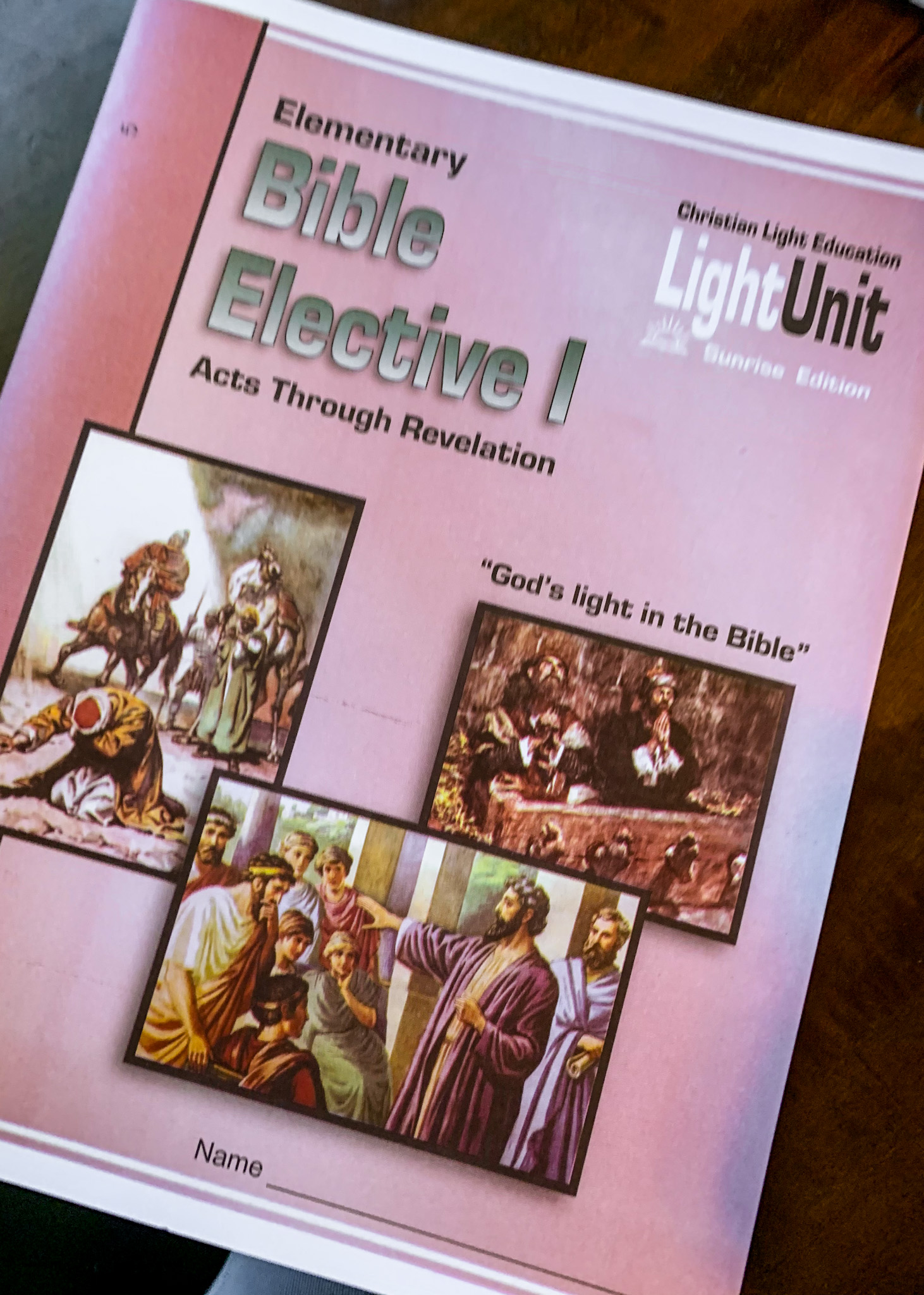
The irony was that the level I was using with my high schoolers was actually a junior high level.  I haven't used the high school levels yet,  and I am uncertain if I will.  The younger levels are incredible!  Called Lightunits, these little workbooks work in conjunction with Bible reading.  The early levels are more closely related to Bible story books with questions and activities thrown in. However, once the student hits the grade five level, the studies get very serious.  The fifth and sixth grade levels go through the Old Testament.  The seventh grade level goes through the Life of Christ.  The eighth grade level covers Acts through Revelation.

When I began homeschooling my step-daughter, I prayed and asked God what he would want me to teach her in the few short years I would have her in my home.  I felt He wanted me to help her have a solid foundation in the Word.  I looked at the high school Bible programs available and they either weren't very solid or they moved so quickly that I feared she wouldn't get much out of it.  I decided on the Grade Five level of Christian Light's Bible, figuring I could been it up for high school if needed.  I liked the fact that we would spend two years going through the Old Testament.  I put my younger daughter, then in eighth grade, into the same Bible program.  Every morning we would gather around the table and go through a lesson a day.  I would read the lessons to them and we would discuss them and answer the questions and have an enjoyable time.  My girls recieved that foundation I desired for them to have.

My now 11th grader is currently doing the grade 8 program with me in the mornings.  Once again, I thought we would try a different Bible program.  It came with the curriculum package I purchased and was cheaper to use that than to purchase a separate program.  BIG MISTAKE!  We both hated the program and ditched it after a couple weeks.

The Christian Light Bible program is a Mennonite program.  I was worried that theological differences would be apparent and cause issues.  But, with the exception of occasional reference to Non-resistance, I haven't encountered much strictly Mennonite doctrinal issues.  The reference to non-resistance are often presented in such a way as to make my daughter's and I think about what the Bible says and what we believe.

I was surprised that a workbook program could hold such an outstanding, incremental Bible program.   Over the last few years we have delved into the Old Testament and the Life of Christ, using maps and  a concordance. We have researched Hebrew and Greek word meanings, supplemented occasionally with a model of the tablernacle or a study on Psalm 23.  I learned things about the Life of Christ that I didn't learn when I took a college-level class covering the same material.

I totally recommend Christian Light's Bible Units.  Delve into the work with your children!  It is totally worth it!

Depriving our Students of the Classics

  In December 27, 2020, an article was published concerning a push to remove the classics from education. Entitled  Even Homer Gets Mobbed ,...