Showing posts with label Dictation. Show all posts

Friday, September 11, 2020

Why we Ditched Spelling

For years I stuck with spelling lists.  Even while using the Heart of Dakota curriculum, I kept using spelling lists.  Or I would use Ace Paces’ Word Building (etymology).  My older daughters completed the full spectrum of Word Building books. 


I always wanted to use the Dictation plans included in Heart of Dakota.  I tried it with my older daughter.  She hated dictation.  She had come from public school and spelling was what she knew.  She asked for the spelling lists.  She likes the Word Building compared to the dictation.  So, I let her continue with it.

But then came my youngest.  She is the one that has never attended public school.  She tried the Word Building paces and began to dread them.  (She wasn’t a big fan of workbook curriculum.). With her, I thought, I could start her with dictation and see if it was truly something that I could trust to give my child a good spelling foundation.


She likes dictation.  Even when we wandered through a couple years of delight directed studies, we stayed with dictation. Occasionally we got our dictation out of McGuffey Readers.  Mostly, we used the dictation provided in the Heart of Dakota guides.  

I love the seamless, steady progress of the passages.  I love that my daughter is putting words into writing, not just memorizing lists.  I love that we can take the time for her to study the passage so she can learn it in her own way. 

Her spelling is good.  Occasionally she misses a word and must redo the passage.  She’s a bit of a perfectionist and gets easily frustrated when she misses, but I just keep encouraging her and we progress slowly forward.  

The spelling and grammar carry over to her other schoolwork, also.  Spelling errors are infrequent.  I believe this is because when you are reading quality literature and writing often, you naturally pick up how words are spelled by seeing and writing them correctly in context often.  With that comes vocabulary, grammar, sentence structure, and a host of good writing habits.


We will continue dictation through high school.  I love to read blog posts from the Heart of Dakota sisters (Carrie and Julie) about how dictation skills carried over into other areas of schoolwork and into college.  

Here are a few posts they have written about dictation:


As you can see, using dictation instead of spelling has many benefits.

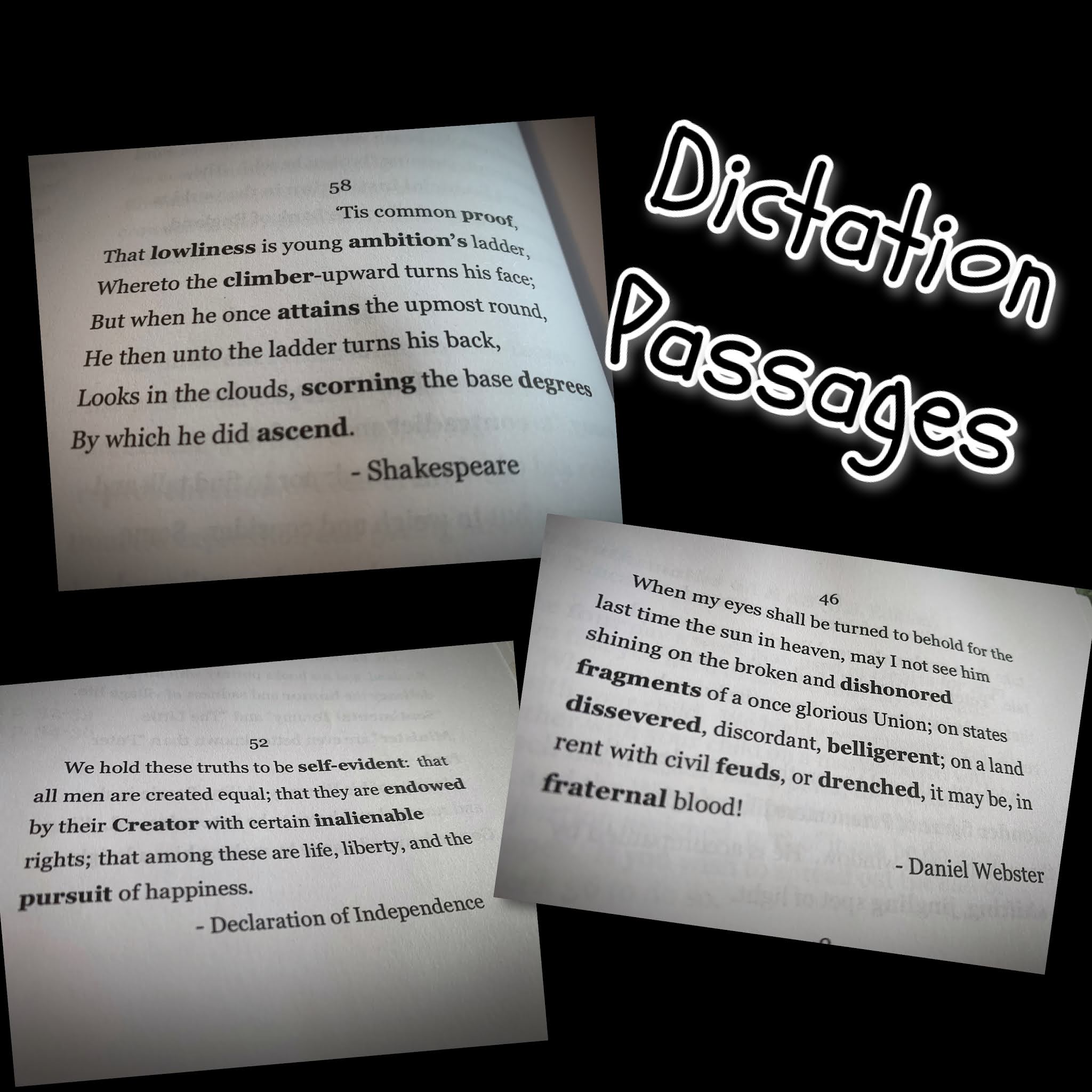
The dictation passages chosen by Heart of Dakota come from an older book set used in schools long ago.  They were published in the early 1900s.  The books are called Dictation Day by Day by Kate Van Wagenen.  With each level, new words are in bold.  Many of the passages are from quality literature or are quotes from famous men and writers.  These writers consist of Ralph Waldo Emerson, Henry Wadsworth Longfellow, Abraham Lincoln, Benjamin Franklin, Oliver Wendell Holmes, Shakespeare, and Daniel Webster... to name a few.  They come from quality works like The Bible or other great works of literature. Not only are the students learning spelling, grammar, and sentence structure, they are exposed to great snippets of writing and the thoughts of great men and women in history. 


In our home, we have developed a system or routine for dictation.  Dictation is part of our morning time studies, which also include Bible time, Writing, Language Arts, math, and Drawn Into the Heart of Reading (Literature) assignments.  

We keep dictation simple.  On day 1 of a new passage, it is used as copywork.  We do this because I think it is a good practice to write to learn.  By copying the passage exactly, my daughter is cementing the spelling of new words, seeing which words are capitalized, and where punctuation goes.  

On day 2, the passage is dictated to her, phrase by phrase.  She has to write it perfectly again.  The Heart of Dakota guide books say that, if there is a mistake, she corrects the error, again cementing the correct spelling in her brain, and then redoes the passage the next day.  Most of the time that is what we do.  Occasionally the mistake is simple and she corrects it as soon as she sees it.  In that case, we will often just move on to the next passage. However, many times the error is one where I insist the passage be redone.  The next day she will redo the entire passage through me restating it, phrase by phrase.  She rarely has to repeat a passage more than once.  

Having used this method now for several years, I am impressed with the simplicity of this Charlotte Mason method. It takes only a few minutes a day, but the slow, steady, incremental growth is apparent when we see how far we progress from the beginning of a year to the end.  Often we cover more than one level in a school year.  And while a small snippet may not seem like much in the day to day, it adds up to a quality education. 

Spelling is one of those subjects that, coming from a public school mentality, is the most difficult to release.  Dictation is a natural way to learn not just spelling, but writing and grammar.  And while we do separate writing and grammar programs, trusting dictation to be enough for spelling is scary at first.  It has been ingrained that we need those lists and rules.  Heart of Dakota asks that parents give dictation at least a year before trying to measure progress because it is a different way to learn from the way we all grew up with in the schools. 

The early years of dictation actually do begin with lists.  As a child is beginning to learn the write, each word in a list follows a spelling pattern, such as: grow, show, tow, throw, stow, etc.  After a year or so of the lists, the first dictation passages are introduced. Spelling patterns are repeated with extra words added that match the dictation.  For instance, the very first dictation passage is:

Sue has a bird.
It can call and sing.
king ring wing

This begins the gentle, incremental climb that continues through graduation.  

I can attest that I have seen the growth and it more than covers the lists.  Each week, with just three different dictation passages, there are fifteen to twenty new words (at my daughter’s current level.).  The upper levels of dictation are quite challenging, with longer paragraphs being included of top quality works that hold a depth of sentence structure and a rich vocabulary that makes those lists a sad substitute.   So while the earlier dictation passages are simple, through the years they advance to impressive levels. 

I encourage other homeschool moms to try dictation for a year.   If you hate it, the lists will always be there.  There is no shortage of spelling programs, both free and expensive, available.  Dictation is different.  I believe it is better than the lists.  I wish I would have stuck with it with my older daughters.  While they are good spellers, using a dictation program teaches so much more than how to spell. 


Saturday, September 15, 2018

Weekly Checkup - September 10-14, 2018


 Weekly Checkup

September 10-14, 2018

This week went quickly.  We didn't do school on Monday as there were appointments.  But, that didn't stop my daughter from being such a good help with her nephew while we were in the waiting room.
On Tuesday, we dove back into our studies... both of us.  My college classes continue, and I work steadily beside my girl. It is working well for us so far this year.


Here's a breakdown of my Meggy's week:

History:  

Megan is continuing to record the prophecies and fulfillments of Christ.  This week was about Christ coming out of Galilee. She is also reading about Assyria and the Assyrian King, Sennacherib.  She finished the book, God King, and began to read the book of Jonah in the Bible.  She continued to read the book, Palace Gates.

Bible:

This week Megan read about Hezekiah and Josiah in The Illustrated Family Bible.  In her New Testament study, she also read about Paul writing to the churches of Ephesus and Colosse. 

Science:

Megan is studying the book Birds of the Air in science.  This week she learned about how birds sing and the different types of nests they build.     Last week, she began a book where she will draw different kinds of birds over the next few weeks.

Poetry:

Megan is studying the poem Once by the Pacific by Robert Frost.  This week she painted an ocean with whitecaps.  (I didn't get a picture.)

McGuffey:

Megan is studying the 48th lesson in the Second McGuffey Reader (original), Stories About the Monkey.   She researched facts about monkeys, drew a monkey picture, answered questions, looked up vocabulary words from the story, and wrote original sentences.

Language Lessons:

In Megan's Language Lessons this week, she first reviewed Capitalization.  She reviewed syllables. Then she dived in to learning about Haiku.  She loves using Language Lessons, because it isn't drill and kill and she gets to write more. 

Literature:

In the beginning of the week, Megan finished up a book project over the book Five Smooth Stones.  She then dived into the next genre, Fantasy.  She will be reading My Father's Dragon and The Bridge for this genre.  She began My Father's Dragon on Wednesday. Her study has her searching out different moods in the book as well as differentiating between realistic and unrealistic aspects in the story.


Having a literature focus, I have assigned extra reading every day. She also finished up Penguin Puzzle in her extra reading and began Scripture Sleuth.

Read Aloud:

We finished up Penderwicks in Spring, which broke our hearts.  It was the best one so far.  We began The Penderwicks at Last.

Dictation:

Megan has been completing her dictation as copywork for a day or two before we do the actual dictation.  I like this pattern as she learns the passage much better and has less repeating due to less errors.  The dictation passages are listed in the back of the Heart of Dakota guide and are taken from Dictation Day by Day: Book One by Kate Van Wagenen.  Megan is on Level 4, passage thirty nine. 

Math:

Megan is using two different math curriculum at this time.  She is using ACE Math and Life of Fred at this time.  I really want to strengthen her skills.  We are still doing some review, making sure the skills are strong before we dive into new material. 

In Life of Fred Goldfish, Meg read chapters 7 and 8, which covered sequencing, algebraic concepts, polygons, and perimeter.

In Ace Math, she practiced place value, multiplication and division concepts, expanded form, and fractions.  She complained at first about going to a "drill and kill" program, but she is changing her attitude.  She is understanding so much better and her confidence is growing as she does well on the problems.

Piano:

Megan has practiced a few times.  Her lessons begin again next Monday. 

This was our homeschool week.  Sometimes I wonder if we are doing enough, especially when she completes her entire day in a few hours.  As I go back through the week and actually type all that she has accomplished, I am surprised.  It is definitely a full schedule with a lot of variety in her learning. 


Tuesday, December 12, 2017

Studied Dictation


Dictation with a touch of art.
 When this semester began, I knew I wanted my fifth grader to get some more writing practice.  Her handwriting isn't the best, but I was more concerned that she get more practice in actual writing.  She is a girl that is very creative, until it is time to retell what she has read or learned in her own words.  Ironically, this only happens with school work.  Most of the time she has no problem being, as her older sister calls her, a "walking Google."  She can spout off all sorts of facts about subjects that have captured her interest.  But, writing this information down seems to be more difficult for her. 

Even though we have taken a semester off of Heart of Dakota, I kept up with the dictation.  My ten year old has advanced through fifty-two dictation passages in the 77 days of school we have completed.  While she usually has to repeat a passage once a week or so due to an error, she is progressing well.  Every day, after she completes the dictation passage, she draws a picture to go with the passage.  I find it cute, and she loves being artistic. 

Dictation is a unique and old-fashioned way of teaching spelling, grammar, and sentence structure.  Truthfully, dictation made me very nervous.  My older daughter despised dictation.  She was happy with her spelling lists.  She is a good speller, so I let her choose.  If the lists worked for her, we went with it.

My ten year old gets sick of lists and workbooks.  She enjoys dictation.  It's fast.  It's effective. She has a passage a day.  They get progressively more challenging as time goes on.  She studies the passage for a few minutes, spelling the words to herself, taking note of punctuation and the general sentence structure, as well as learning the meaning of the words as they are used in the context of the passage.  After a few minutes of study, I "dictate" the passage to her, usually phrase by phrase, and she has to write it perfectly.  She can't misspell words.  The punctuation must be correct.  I even expect it to be neat, with decent handwriting.  

The passages are taken from the Heart of Dakota guides.  Heart of Dakota took the passages from an old spelling program entitled Dictation Day by Day by Kate Van Wagenen.   These passages were published in the early 1900s, and are not available for free in the public domain.  The passages are sorted into levels, with a student moving forward at their own pace, mastering the passages of one level before advancing to the next.  This is how I love teaching... in a mastery based way


My ten year old is doing well in dictation.  I wasn't very consistent at first, and would do dictation as well as a spelling program.  However, I can see the genius behind the choice as we progress.  Words are learned in context.  Further in the dictation levels, quotes and passages from classic literature are added. 

"The whole secret of spelling lies in the habit of visualizing words from memory, and children must be trained to visualize in the course of their reading".  Charlotte Mason

The passages begin as short ones.  Eventually they will be long passages of beautiful literature.  Dictation continues into High School for Heart of Dakota, giving the child exposure to incredible literature passages in writing, not just in reading.  As the child advances, he or she will gain incredible writing and spelling skills by examining great works of literature and seeing the words in context, not simply by getting a new word list every week or completing vocabulary worksheets.

Dictation is more challenging than spelling individual word lists because you have to hold the sentence in your head.  This means that you can't just learn the word, place it in short-term memory,  pass the test, and then forget.  The words in one passage will be reused in different sentences in a later passage, repeating until the words are part of the student's vocabulary and spelling them is natural.

When my daughter misses a passage, that means she has an error or errors.  Perhaps she misspelled a word. Perhaps she forgot punctuation.  There isn't a big deal made about it.  She didn't "fail."  She simply repeats the passage the next day.  She studies what she missed and reviews what she got correct.  The point is for her to succeed, even if it takes multiple attempts.  She is to be challenged, not overwhelmed or feeling like she failed in some way.  Slowly, as she progresses through the passages, she will improve her writing, spelling, and vocabulary.  Studying literary passages will also help her reading and speaking.

Imagine, if you will, year after year of slow progress through high quality passages, writing and mastering them, advancing until you reach graduation.  These are students that will be well-spoken and write extremely well.  Spelling.... writing is so much more than spelling. Writing well begins with having the ability to think clearly.  Using studied dictation helps achieve that aim.  Some of the quotes come from Tennyson, Ralph Waldo Emerson, William E. Channing, Benjamin Franklin, Wordsworth, Abraham Lincoln, Oliver Wendell Holmes, Longfellow, Shakespeare, and more.

To show a bit of the progression of work, here are some samples of the dictation passages at different levels:


Level 2:


I am going out to pick the corn.  It is ripe now.  Two women will help me.  born  horn

Level 3:
Nearly every day the rose's pretty face was washed by the dew.  Was the dear little flower happy when it felt the drops of dew?

Level 4:
Robin Hood was captain of the band.  Little John was second in command.  Friar Tuck was another one of Robin Hood's men.  Maid Marian also lived in the forest and cheered them all with her sweet music.

Level 5:
Her brain soon became very active, and she was taught grammar, and arithmetic through fractions.  She gained a knowledge of geography from a raised map.  She was fond of sewing and knitting and never spent an idle moment.

Level 6:
Grown people do not always like to see the snow whirling about.  They know it means more coal for the furnace.  Boys cannot use their bicycles and must often shovel snow, and yet most of them prefer this season. 

Level 7:
There are some Eastern countries where many unhappy missionaries have been attacked by soldiers who resented the introduction of Western ideas.  Those who escaped death were often separated from their friends, kidnapped, and conducted across the frontier.  There they received instructions never to return.

Level 8:
In accordance with an old custom, the hereditary kings of France were always crowned with their standards raised in the cathedral at Rheims.  Charles, the Dauphin, felt confident that, if he could be crowned as the rightful sovereign, his claim would then be absolute and unquestioned.

As you can see, studied dictation is so much more than a list of words. 


Depriving our Students of the Classics

  In December 27, 2020, an article was published concerning a push to remove the classics from education. Entitled  Even Homer Gets Mobbed ,...