Showing posts with label Charlotte Mason. Show all posts

Friday, September 11, 2020

Why we Ditched Spelling

For years I stuck with spelling lists.  Even while using the Heart of Dakota curriculum, I kept using spelling lists.  Or I would use Ace Paces’ Word Building (etymology).  My older daughters completed the full spectrum of Word Building books. 


I always wanted to use the Dictation plans included in Heart of Dakota.  I tried it with my older daughter.  She hated dictation.  She had come from public school and spelling was what she knew.  She asked for the spelling lists.  She likes the Word Building compared to the dictation.  So, I let her continue with it.

But then came my youngest.  She is the one that has never attended public school.  She tried the Word Building paces and began to dread them.  (She wasn’t a big fan of workbook curriculum.). With her, I thought, I could start her with dictation and see if it was truly something that I could trust to give my child a good spelling foundation.


She likes dictation.  Even when we wandered through a couple years of delight directed studies, we stayed with dictation. Occasionally we got our dictation out of McGuffey Readers.  Mostly, we used the dictation provided in the Heart of Dakota guides.  

I love the seamless, steady progress of the passages.  I love that my daughter is putting words into writing, not just memorizing lists.  I love that we can take the time for her to study the passage so she can learn it in her own way. 

Her spelling is good.  Occasionally she misses a word and must redo the passage.  She’s a bit of a perfectionist and gets easily frustrated when she misses, but I just keep encouraging her and we progress slowly forward.  

The spelling and grammar carry over to her other schoolwork, also.  Spelling errors are infrequent.  I believe this is because when you are reading quality literature and writing often, you naturally pick up how words are spelled by seeing and writing them correctly in context often.  With that comes vocabulary, grammar, sentence structure, and a host of good writing habits.


We will continue dictation through high school.  I love to read blog posts from the Heart of Dakota sisters (Carrie and Julie) about how dictation skills carried over into other areas of schoolwork and into college.  

Here are a few posts they have written about dictation:


As you can see, using dictation instead of spelling has many benefits.

The dictation passages chosen by Heart of Dakota come from an older book set used in schools long ago.  They were published in the early 1900s.  The books are called Dictation Day by Day by Kate Van Wagenen.  With each level, new words are in bold.  Many of the passages are from quality literature or are quotes from famous men and writers.  These writers consist of Ralph Waldo Emerson, Henry Wadsworth Longfellow, Abraham Lincoln, Benjamin Franklin, Oliver Wendell Holmes, Shakespeare, and Daniel Webster... to name a few.  They come from quality works like The Bible or other great works of literature. Not only are the students learning spelling, grammar, and sentence structure, they are exposed to great snippets of writing and the thoughts of great men and women in history. 
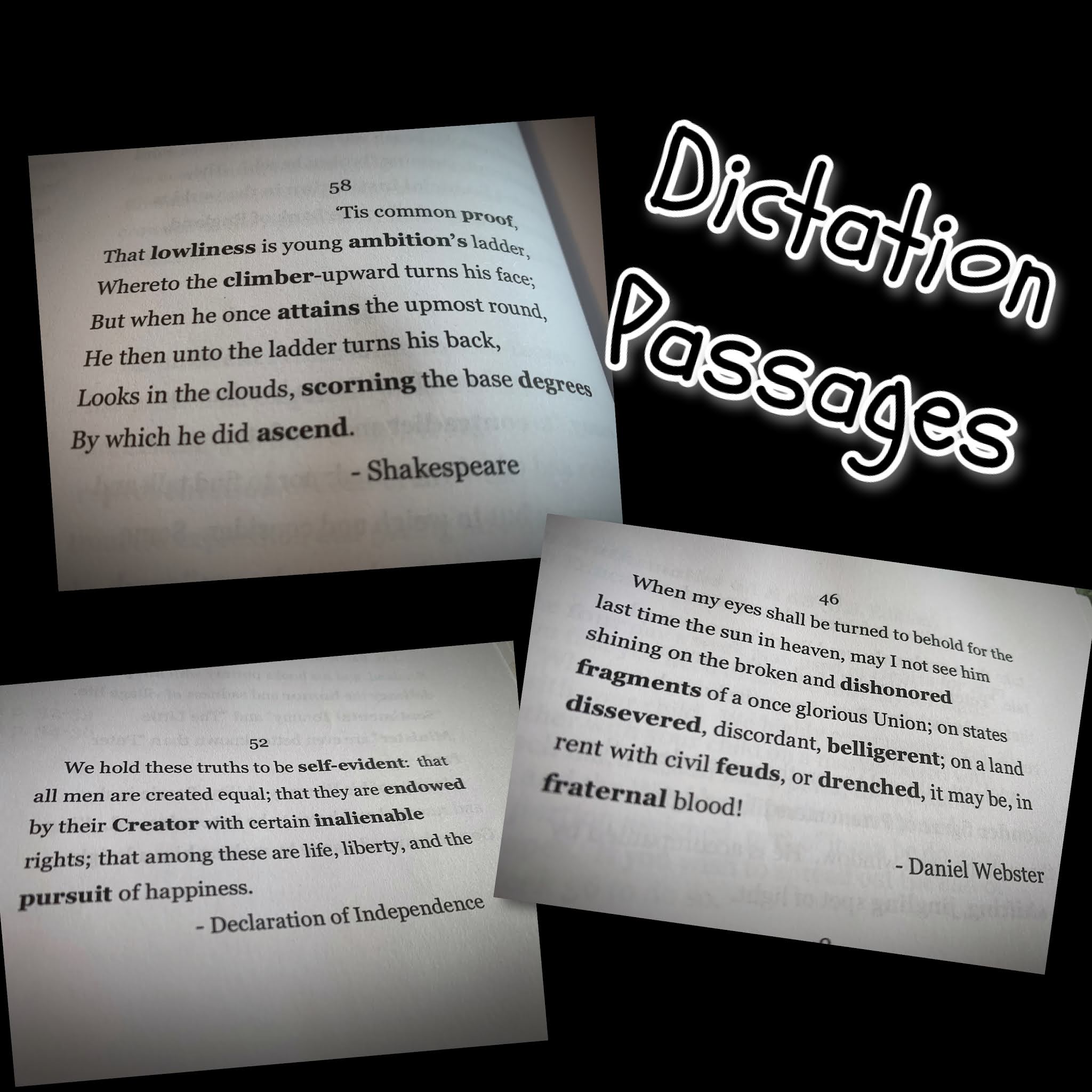


In our home, we have developed a system or routine for dictation.  Dictation is part of our morning time studies, which also include Bible time, Writing, Language Arts, math, and Drawn Into the Heart of Reading (Literature) assignments.  

We keep dictation simple.  On day 1 of a new passage, it is used as copywork.  We do this because I think it is a good practice to write to learn.  By copying the passage exactly, my daughter is cementing the spelling of new words, seeing which words are capitalized, and where punctuation goes.  

On day 2, the passage is dictated to her, phrase by phrase.  She has to write it perfectly again.  The Heart of Dakota guide books say that, if there is a mistake, she corrects the error, again cementing the correct spelling in her brain, and then redoes the passage the next day.  Most of the time that is what we do.  Occasionally the mistake is simple and she corrects it as soon as she sees it.  In that case, we will often just move on to the next passage. However, many times the error is one where I insist the passage be redone.  The next day she will redo the entire passage through me restating it, phrase by phrase.  She rarely has to repeat a passage more than once.  

Having used this method now for several years, I am impressed with the simplicity of this Charlotte Mason method. It takes only a few minutes a day, but the slow, steady, incremental growth is apparent when we see how far we progress from the beginning of a year to the end.  Often we cover more than one level in a school year.  And while a small snippet may not seem like much in the day to day, it adds up to a quality education. 

Spelling is one of those subjects that, coming from a public school mentality, is the most difficult to release.  Dictation is a natural way to learn not just spelling, but writing and grammar.  And while we do separate writing and grammar programs, trusting dictation to be enough for spelling is scary at first.  It has been ingrained that we need those lists and rules.  Heart of Dakota asks that parents give dictation at least a year before trying to measure progress because it is a different way to learn from the way we all grew up with in the schools. 

The early years of dictation actually do begin with lists.  As a child is beginning to learn the write, each word in a list follows a spelling pattern, such as: grow, show, tow, throw, stow, etc.  After a year or so of the lists, the first dictation passages are introduced. Spelling patterns are repeated with extra words added that match the dictation.  For instance, the very first dictation passage is:

Sue has a bird.
It can call and sing.
king ring wing

This begins the gentle, incremental climb that continues through graduation.  

I can attest that I have seen the growth and it more than covers the lists.  Each week, with just three different dictation passages, there are fifteen to twenty new words (at my daughter’s current level.).  The upper levels of dictation are quite challenging, with longer paragraphs being included of top quality works that hold a depth of sentence structure and a rich vocabulary that makes those lists a sad substitute.   So while the earlier dictation passages are simple, through the years they advance to impressive levels. 

I encourage other homeschool moms to try dictation for a year.   If you hate it, the lists will always be there.  There is no shortage of spelling programs, both free and expensive, available.  Dictation is different.  I believe it is better than the lists.  I wish I would have stuck with it with my older daughters.  While they are good spellers, using a dictation program teaches so much more than how to spell. 


Wednesday, August 5, 2020

A Tale of Two Levels: Part One


Eighth grade is upon us.  Since we did some other things last year, we could say we are “behind.”  But most homeschoolers know there is no “behind.”  The time away from Heart of Dakota was still filled with learning.  The beauty about Heart of Dakota is that the skills build on each other.  We can just pick up where we were and move forward as long as the child hasn’t progressed too far.  

So a few weeks ago we began eighth grade with half days because Covid had led to the cancellation of nearly every activity in which we normally participate.  Not willing to have a summer of YouTube videos, we began some school.  We picked up right where we left off and have kept moving forward.

However, we are over halfway through Heart of Dakota’s Resurrection to Reformation guide.  This means we will actually do two guides this year.  Megan will finish up Resurrection to Reformation by Christmas.  We will immediately begin Revival to Revolution. 

Part One: Resurrection to Reformation


I’ll go through the first part of our school year by going through Resurrection to Reformation and other things we are using.   There are a LOT of books my daughter will be reading.  That isn’t unusual for our homeschool.  

History:

With Mystery of History as the main spine for the remainder of the guide. Megan will be reading about Shakespeare, Leonardo da Vinci, Sir Walter Raleigh and so much more.  She will read and notebook her way through time as she learns history. 


I love the notebooking pages!  They are colorful and of great quality.  The lessons are so enhanced by the pages!  And it is such a fun way to keep track of what my daughter has learned. 

Science:

My daughter loves Earth Science, so finishing up this study is a joy for her.  She is relishing the experiments and often loves to tell me all about what she is reading. 


Resurrection To Reformation does a Shakespeare study.  I was afraid this study would be difficult for my child.  Instead, she LOVES it!  She gets excited when it is Shakespeare day.  Like the history notebooking pages, Heart of Dakota has created these beautiful Shakespeare notebooking pages. And they chose Charles and Mary Lamb’s Tales from Shakespeare.  Tales from Shakespeare is written in more modern English for younger readers. 

Bible:

Heart of Dakota’s Resurrection to Reformation uses the inductive Bible study Hidden Treasures in Philippians.  This is scheduled as an independent study to help the child develop good habits in their own personal Bible time with God.  However, I am planning to do this with my daughter.  She is at a sensitive age, and being able to discuss the study with her is important to me.  (Plus, I don’t want to miss out!)

We also have a different Bible study we do every other day or so from Christian Light Education.  I love how deep Christian Light goes into the Bible.  


Reading:


We are continuing with Heart of Dakota’s Drawn Into the Heart of Reading.  I love the perks of this program! I can choose which books to use for the different genres.  I can use library books to save money.  Or, as I tend to do, I can use books I have already purchased over time.  I like the choices Heart of Dakota gives in their book packs, and have used them often also.  But sometimes I switch out the book for something else. 

Extra Reading:

I chose two book series to slowly have Megan read through over the next two years.  These aren’t assigned in Heart of Dakota, but instead are something extra I want my daughter to experience.  She is reading them slowly so she can mature a bit with the characters as they age in the books.  I also want her to savor the books and think about the lessons contained.

The first series is a rewrite of Martha Finley’s Elsie Dinsmore series.  I read them all several years ago from the library.  Mission City Press did such a great job with these books and I am sad they aren’t as easily purchased now.  I still have the last two to purchase before we own the entire set.  Megan will read through at least three of the books this year. 


The second series is the Terrestria Series by Ed Dunlop.  I was first introduced to the series through Heart of Dakota when they offered a couple of the selections in the book packs for Drawn Into the Heart of Reading.  The books are allegorical and engaging.  My daughter often likes fantasy books, and these are very godly.  It will take her two years to get through this entire series when alternated with Elsie Dinsmore.  . 


What’s left?

In the next post I will go through what we are using for Revival to Revolution as well as what we use for math and any alternatives I am using.  It looks to be a very full year!


Wednesday, April 27, 2016

Why I Love Literature-Based Curriculum

"The man who does not read good books has no advantage over the man who can't read them." - Mark Twain

I have talked before about my curriculum hopping.  I learned many lessons during this time of trying some of this and some of that.  What I have found is what many homeschooling pioneers have known for decades:  reading provides a deep education. 

I went back to Heart of Dakota this year because I love the reading selections.  With Heart of Dakota I'm not locked into any certain math or English. I can use what works for us if what they have suggested isn't my favorite.  I can add or take away.  I can slow down or speed up.  

Heart of Dakota is a literature-based Curriculum that, I believe, is well-balanced and flexible. There are lots of read aloud books scheduled in the earlier years, with suggestions for more.  Older children can add depth in study by using extra supplemental books that are scheduled for each unit in the appendix.  

The read aloud books are very gentle.  I like that.  In a busy time, where maybe the mom doesn't have time to read aloud as much, the scheduled read aloud books only take a few minutes each day. In the early years, a mom may read a short history lesson, a bit of science, a poem, and maybe a chapter of a story. As the child gets older, the read aloud books may get a bit longer, but the child also grows more independent and will begin reading the science and history for his or her self. Slowly independence is built through the years. 

"I read to live. Every book I've read and every story that has made itself a part of my imagination has taught me something about what it means to live life well. I'm passionate about reading because I'm passionate about life."  -Sarah Clarkson in Read for the Heart

For the mom that wants more, we can add more.  If we want more read aloud time, there is a whole list of selections.  Or, we can read books that maybe the curriculum doesn't contain.  For example, Megan and I just read The Prairie Thief by Melissa Wiley for our bedtime read aloud.  I like some of the Abeka novels and have scheduled them as literature books for Drawn Into the Heart of Reading.  This summer we have plans to delve into The Chronicles of Narnia!  Extra reading doesn't take away from the beautiful selections and choices in Heart of Dakota.  We are currently reading and loving Understood Betsy for our Storytime selection!  


I have respect for all literature-based curriculum.  Heart of Dakota adds some more Charlotte Mason aspects that I enjoy, such as dictation and nature study. However, I tend to occassionally skip projects that are assigned if I don't think they are vital.  We do many of them, especially in the younger years when a hands-on learning helps developmentally.  Curriculum is a tool, and I can pick and choose if necessary.

"We read because it is personally enjoyable and fulfilling. Reading is an adventure of the heart and the imagination. A well-written book is a joy to read, whether it is fiction, inspiration, biography, history, poetry, or any of a multitude of writings. Rather than being a passive pleasure like most media, reading is an active pleasure that engages, enlivens, and enriches the whole inner person."  Clay and Sally Clarkson in Educating the WholeHearted Child. 

There are times I need simple.  Every morning is workbook time for my youngest.  It may go against some beliefs, but workbooks for some subjects simplify work.  As Megan works through her handwriting or English workbook, I know she is getting a line upon line, precept upon precept journey through skills. Using a workbook doesn't take away from the marvelous benefits of reading that comes from all the good books we are ingesting.  It is just some balance for me as a busy homeschooling mom. 


I trust Heart of Dakota. I know that my children are getting an education, a foundation, in the Word of God.  They curriculum is very Biblically based. While we may do a lot more reading than scheduled in the Teacher's Guide, I know that the core is solid.  The core of Heart of Dakota is a well-balanced meal.  The extra reading I choose to do is like a vitamin for an extra boost if I desire. 

Every time I doubt myself, I go back to the foundation of what I believe is a good education.  My children are getting a strong foundation in the Bible.  They are delving into history and science from a biblical perspective.  They are introduced to characters, real and fictional, and stories and ideas through living books that are priceless treasures for the soul. 

I know there are other literature based, Christian homeschool curriculum companies that are top quality.  I know that at least one company contains much more reading aloud, which would mean I wouldn't need to schedule so many extra books on my own.  But, I like the flexibility I have to choose for myself.  I can bring home a feast of books and audiobooks from the library, pick up a small collection from the Goodwill an hour away, or fill the Amazon cart with new recommendations.  I can read through an entire series, such as what we did with the Borrowers, or study the works of one author, such as we are slowly doing with Andrew Clements.  The choice is ours.  All our time hasn't been taken up by a schedule of books that, while wonderful, may not follow the rabbit trail we desire to take. 

Heart of Dakota may have a lighter reading schedule, but it is thorough and high quality.  A top quality education will be obtained by following Heart of Dakota's program, even if nothing else is added.  However, the flexibility is freeing.


Monday, February 8, 2016

Developing A Love of Literature

Some of our books have arrived for our move to Heart of Dakota's Bigger Hearts for His Glory.  One of the books I ordered was the Student Book, level 2/3, for Drawn Into The Heart of Reading (DITHOR).  Along with some DITHOR level 2 reading selections and some books I own, I think that Megan's reading time will be awesome!

Megan reads advanced books.  She generally likes science books.  However, DITHOR is a program that introduces her to many different genres through read-aloud time and independent reading.  While Megan can read advanced material, I liked the idea of Charlotte Mason's way of savoring books by reading them slower and drawing more out of them.


The result is I am slowing her down.  I already owned the 4/5 Student Book for DITHOR as well as the Teacher's Guide.  Megan could do the 4/5 lessons, but I didn't feel she was doing her best work.  Some of the concepts were escaping her in her effort to complete the assignments.  She could do it, but she became more focused on doing the pages than on absorbing what the pages were meant to teach her.


I bought the 2/3 Student Book and grade 2 project book.  This evening I reviewed the Student Book.  I skimmed through the DITHOR level two selections along with the Student Book and Teacher's Guide. I realized how very much I LOVE the program!


The level 2/3 Student Book and level 2 readers (reading levels 3.1 - 4.0) are perfect selections for engaging my third grader without the reading being too much.  Megan may be able to read more advanced materials, but I am not looking simply for skill.  I'm more concerned with developing her love of literature!


As a young reader, I fell in love with reading by reading books that were considered "easy."  I must have read the Little Golden Books on my grandmother's shelves a couple dozen times each.  I still credit Looney Tunes' Sylvester and Tweety for engaging me in a simple story when I was a beginning reader.


In my older years I became hooked on Sweet Valley High books. Yes, it would be considered "twaddle," but I felt I knew Jessica and Elizabeth.  Their lives comforted me with happy endings.  During the years I moved often and was always the new girl at school, they were familiar friends. 

Characters were my friends in many novels.  I read the Little House series so much that I named a daughter Laura Elizabeth in honor of Laura Ingalls Wilder. I discovered I had a kindred spirit in Anne Shirley after reading Anne of Green Gables.


I fill our read-aloud time with lively characters.  My daughters will often take the books I have read to them and re-read them independently.  I want the same for the books they read.  I want the characters to come alive!  I want the stories and the characters and the places and the lessons to impact my children for a lifetime.


DITHOR helps draw out those very things.  While I chose some of the suggested books sold by Heart of Dakota, I have the choice to use whatever book I wish with the program!  This program works with any book as long as it matches the genre we are studying. For instance, if we are reading a mystery, I can go to the library and look for any mystery that I think will be in my child's reading level and catch her attention.  From Nancy Drew to Sherlock Holmes, Encyclopedia Brown to the Hardy Boys, from Ginger Pie to Scripture Sleuth, the choices are endless and mine.
  

I plan to use the 2/3 Student Book for the rest of third grade and then through fourth.   I have the 4/5 Student book and the 6/7/8 Student Book to use until High School. I have used these guides with my older daughters and have seen how awesome they can be both educationally and in touching the hearts of students for Christ. 


Saturday, January 16, 2016

Slow Immersion, Smooth Sailing

A few weeks ago I pulled out the Preparing Hearts for His Glory program that Laura used in fifth grade.  Megan is only in third, but I felt that the Charlotte Mason style learning of short lessons would help focus.  I slowly began to merge Megan from what she was doing into the program.

Megan probably needed to use the Bigger Hearts for His Glory guide. I had decided to take some time off of Heart of Dakota with Megan, hoping that other things would help her be more independent in her work.  Well... she was independent, but her retention and boredom rate skyrocketed.  I was constantly looking for ways to spice up her lessons.  I finally realized that was silly, but couldn't afford to purchase a new program.  Laura had begun Heart of Dakota with Preparing Hearts, so I had never purchased the Bigger Hearts program.


The lessons have been a roller coaster in Preparing Hearts.  She has done well with everything except the writing.  While we have studied cursive, she still is working on writing cursive without it being on a practice sheet.  The copywork in cursive is difficult for her.  Bigger must have been the guide to focus on written narration, because Megan struggles with it sometimes.  She either can't think of what to write or wants to write a page.


The reading is easy for her, but I finally took over the teacher-directed reading.  She is able to read the words, but I noticed her comprehension was going down.  So, I decided to follow the guide and do the reading aloud as directed.


We have done dictation for two weeks now, laying aside our spelling program.  This has been a wonderful change!  Megan doesn't like change, and was comfortable with her workbook pages.  However, now that she has done dictation for a couple weeks, she loves it!  It is faster and less mundane.  Laura always hated dictation.  We ended up going back to spelling for her, and she is a good speller.  However, every child is different.  I realize now that I started Laura off on too high a level of dictation because she is a good speller.  Spelling is only part of dictation.  Dictation is this wonderful seeing a passage of writing, studying it, and then writing it perfectly as it is dictated to you.  This encompasses spelling and sentence structure and grammar and seeing the passage and words in your head.


One of the problems we have had is the time our school day has taken.  Megan is easily distracted.  I realized that long lessons were failing because, halfway through, she would be doodling or watching her sisters or playing with the cat.  One of the worst areas for this was math.


Heart of Dakota recommends Singapore Math.  Again, I tried this with Laura years ago and it was a dismal failure.  She needed the extra review.  I did not want to try this with Megan.  However, after reading many posts on the Heart of Dakota message board about other moms whose children have ADHD and their success with Singapore, I began to reconsider.  Then I read an article by a mom who was frustrated that her ADHD child was in tears every day by the spiral, lots of drill program.  This mother started math over with her eight year old son, using Singapore.  She began with 1A.  Within two years her son was not only on track, he was advanced in testing and his whole attitude toward math had changed.


Singapore is advanced, and uses a lot of mental math.  I have gone back a little and am redoing some math with Megan using Singapore.  The day does go faster when we aren't spending an hour or two trying to have her get a lesson completed.  I am still "seeing how it goes."  I know that the Bigger Hearts guide has some amazing activities to help teach mathematical concepts taught in Singapore.  I have used the ones up to the Bigger guide.


One final area that I am changing next week is Megan's grammar.  As with all areas of Megan's school, she has been taking forever to complete the workbook pages.  Heart of Dakota recommends Rod and Staff English, done at a gentler pace than typical grade level since it is also advanced.   My plan is to try it for a few weeks, like we've done with all our changes, and see if Megan learns and retains.  Heart of Dakota recommends doing a lot of the Rod and Staff lessons orally, to save the long, drawn-out copying of endless sentences.  I like the idea of knowing immediately if Megan understands, instead of grading the workbook later and finding out she misunderstood a concept and needs to redo pages.


Megan isn't the only student going back to Heart of Dakota, though she is the only one doing so this semester. I hope to blog more about that decision at a later time, when more has been decided.

My prayers for my Megan in our homeschool are for whether to stick with the program we are using, or to go back and have her do the Bigger Hearts for His Glory program, maybe with extensions.  To go back would give Megan the time to mature and the practice in cursive and copywork and written narrations that she has missed using different materials.  However, I also know she is enjoying much of what she is learning. I am praying right now for direction and waiting until our budget allows us to purchase next year's curriculum.


Watching my sweet little daughter start to enjoy her school work, because the lessons aren't long and we have added back variety, is a breath of fresh air. For a little over a year, homeschool was not something that my heart was focused on the way I knew it should have been.  Overwhelmed by changes and health issues, I needed a more self-led curriculum. It did what I needed for awhile.  Now that I seem to be getting my focus back, life is getting back to what I need it to be.  For that, I am thankful to my Lord. 

Monday, January 4, 2016

First Day of Dictation

We have been slowly implementing more and more of a Charlotte Mason approach to education for my eight year old.  Having used Heart of Dakota off and on for years, this isn't the first time that we have ventured into Charlotte Mason's world.  However, some areas just haven't made sense to me.

I attempted dictation with my older daughter when she was younger.  She didn't like it.  In truth, since I didn't understand how it worked and had been taught formal spelling in public school, I didn't use it long.  I also probably started Laura off on a much higher level than I should have.  She was naturally adept at spelling, so I just assumed she would breeze through dictation.  When she didn't, I complicated the whole matter.  I didn't understand that dictation was about so much more than spelling.

I have been using a spelling program with Megan since phonics.  She is also a naturally good speller. However, our lessons seem to take forever.  Charlotte Mason advocates short lessons.  With Megan's ADHD, long lessons give her way too much time to lose focus.  Suddenly, instead of her lesson, she will be doodling or playing with the cat. 

I began reading and researching over Christmas Break about ways I could help my little ADHD girl to do well.  Charlotte Mason has sparked a lot of interest.  I have used some of her methods previously, but skipped others.  As I researched, I found a lot of articles and blogs about how Charlotte Mason's methods and philosophies help ADHD children.  Short lessons and time outside and developing habits all contribute to the success of children that may struggle with traditional methods. 

Since I already have Megan using Heart of Dakota, I realized that I just needed to actually follow more than the science and history plans.  There is a beauty to the way of learning that Heart of Dakota's developer, Carrie Austin, has woven into each program.

My little Meggy is an excellent reader.  She is very artistic.  She has a vivid imagination.  She is intelligent.  If she can benefit from shorter lessons, then I am willing to try. 

I followed the instructions for her first dictation.  I spent some time on Heart of Dakota's message board, gathering further tips.  Megan studied the first passage.  I read out the first sentence.  She said it back to me and then wrote it.  

This all took five minutes.  Instead of two or three workbook pages, we were done quickly.  She liked that we were finished so quickly.

Of course, I purposely started her on an easy level.  My goal is to ease her into dictation.  I want to build her confidence. I want to see her form the habits of visualizing the passage.  I want to build her abilities to add in punctuation.  I want to see her skill level build slowly and methodically. 

I will be slowly implementing other Charlotte Mason inspired changes to our schooling and our lives over the next few weeks.  I look forward to writing about them. 

Monday, December 28, 2015

Mixing Things Up


Over the years I have drifted towards an eclectic method of education.  For some subjects I love workbooks.  They are simple and don't burn me out.  For other subjects I enjoy living books.  I love stories and being able to add in notebooking and activities.  These areas seem to contrast, but in actuality, we all learn well with a variety.

It's mid-year, and I usually pray about what we have been using and make any changes needed.  This year I had already made some changes.

Megan is doing some workbooks for a handful of topics.  She is working steadily through English and Spelling and math through a couple different workbook curricula.  She is using occasional workbooks for some literature.

She was becoming bored with workbooks for every subject, as I suspected she would eventually.  I pulled out Laura's Heart of Dakota's Preparing Hearts for His Glory.  I have used Heart of Dakota with my girls for years, off and on.

Starting Megan in Preparing would mean she would skip the Bigger Hearts guide.  I don't own Bigger, however, and knew the funds to purchase the guide wouldn't be available for several months.  I started Preparing, deciding that if it was too challenging, I could go back to other things until I had the funds. 

Bigger is such a fun looking guide that not doing it has made me question myself a few times.  However, Megan is doing well in Preparing.  The hardest part seems to be that her writing, both the cursive and putting sentences together, needs more practice.  Technically, Megan is only a third grader.  The reading and narration is not a struggle for her. She is devouring the science!  She loves the Bible time. 

To help her catch up in cursive and putting together the sentences, I've decided to take Preparing at half-speed.  Megan will do daily English and build up her skills in cursive while we take our time through Preparing.  She has her nature readers and lots of books to supplement the areas where she is only working half-speed.  Technically, Meg could easily do Bigger, but her reading is advanced and I would have to add in the Extension package.  I already have all the supplies for what we are doing. 

Next year I will be investing in Missions to Modern Marvels for Laura, beefed up for High School. That alone will be a large investment.  However, I have discovered that the price isn't all that expensive when most of the program is non-consumable. While I love workbooks for certain subjects, it is nice to realize the bulk of our schooling is already purchased, in a crate in our storage closet. 

Heart of Dakota is one of those programs where you can use alternatives if you choose.  It's easy to beef up if it's not challenging enough, or to slow down if it's too challenging. Since I can add my own English, math, and literature, it really is quite customizable.  Since it is working well for my daughter, I plan to keep using it. 


Thursday, November 5, 2015

A Little Variety

Megan was bored.
Megan, devouring her Nature Reader

It happens often with our homeschooling.  I get burnt out by the curricula that takes so much time and effort planning.  I switch to a workbook or computer program for awhile, but one child just gets bored.
The tree that Megan drew for her CM history

Should I jump around a lot?  Well... I don't.  I have some subjects that stays the same no matter what.  Then, I have a couple where I am more "flexible."  Megan has been working through some workbooks, but she got bored.  It was taking her longer and longer to complete school.  The workbooks provide great structure and give the teacher (me) a nice break, but I knew it wouldn't last forever, for every subject.

Luckily, I have Laura's curriculum that she used when she was younger.  Megan began some Charlotte Mason style history today.  We'll add in the science when she finished what she is doing.

Did I change everything?  Nope.  I've learned that curriculum is a tool, not a master.  I still have the workbooks for the things that are working.

I use a variety of things, and I know that my daughter is getting a quality education.   She isn't learning with just one method.  We aren't only using workbooks or computers or literature-based.  We aren't only using Charlotte Mason or classical.  We have become very eclectic and a bit more relaxed than I was with my older daughters.


Friday, May 1, 2015

Seven Years, Seven Lessons - Lesson One

Lesson One - It's Okay To Use Schoolish Materials!
My girls in that first year.

I think it is the most guilt producing quote ever published in the homeschool world.  "Don't base your school after the public schools."  There are entire articles and blogs and curriculum based on this thought.  And, the thing is, most of us start out basing our homeschool on our own learning history.  We may think we want different, but we still often start with what we know, how we were taught.

What was intended to set us free can actually add more pressure at times.

When I first began homeschooling several years ago, I had an idea in my head about how I would homeschool my child (we started with just one).  I went to a bookstore that sold used homeschool materials and bought the first math program in my daughter's grade.  I bought a spelling book and some workbooks.  I picked up some library books.  That was school to me.  She was in the third grade.  My idea of school was some workbooks and lots of reading.  I read to her... a lot... and I think that was the best thing I could have done for her at the time.
Two of my homeschoolers

Immediately I stressed because she wasn't getting the math.  Turned out it was too advanced, as many homeschool math programs are compared to public school.  So, I bought a different book and off we went.

That first year, when I look back over my blog posts, I was so scared.  I would read all this amazing stuff by other homeschoolers and think they had the answer.  One of the first things I read, and then read and read and read was that making our homeschool  into school at home was BAD!  And, after seven years, I agree... and disagree.
Notecard timeline

We don't have a chalkboard.  We don't have desks, except the computer desk.  We don't raise our hands to ask a question.  So, in essence, we aren't reproducing school at home.  However, I took this to mean that we should not use school materials much if there was a better way.  After a few months I really didn't care about what the schools were teaching, except in math, and if what I was teaching was lining up.  However, I thought that by using "schoolish" type stuff, such as textbooks or workbooks.  They were all dry and boring and will create children that can't think for themselves and will never get a quality education. 

Yes, that is what many of those articles and posts said... and still say to this day.

Are they right?  Well, sometimes... in some subjects.  I would try the use "real" books for everything, especially history and science.  I would spend a ton of money or would check out piles of library books.  I would spend hours planning.  And, it wasn't bad.  My daughter and I enjoyed many of those books.  However, often she would be sick of all the reading.  She is a good reader, but even for her it was overload at times.  I had a toddler, and felt like I was trying to have read aloud time in a tornado.  My toddler wasn't much for nap time either, so that plan usually didn't pan out well.
Math Games

In frustration, and because I couldn't tell how much my daughter was learning, I would order the workbooks.  For awhile she would work on those.  She was such a good reader that they were usually too easy... again, except for math.  I didn't think about trying a harder level at the time.  My daughter would do well with the workbooks... too well.  Then I would read yet another article about how school materials like workbooks were so horrible and I needed to be using "real" books, and I would stress and worry and wonder if I was failing my child.  I would pray for God to show me the right CURRICULUM.  Surely, there was one curriculum that was perfect... and affordable.  The answer had to be a curriculum, and since school materials were bad, it must be a curriculum company that used "real" books.

I didn't mention that, while we used the workbooks, I also had some of those "real" books scheduled.  I also kept doing read aloud time when I could.  I just assumed that I was cheating my child out of a quality education.

Then came the Charlotte Mason curriculum loaded with those magic "real" books.  It was like Christmas morning when box day happened and all those wonderful books arrived.  There is nothing like the smell of opening a box of brand new books.  I LOVE BOOKS!!  This was perfect!  Now, my daughter and I would have all these adventures, learning along the way.  And, there were days when it was fun.  We both love books.  I had all the scheduling planned out for me with a handy little guide.  As long as nothing went wrong, we were great.  But, nothing is perfect.

I got sick.  My gallbladder started giving me attacks.  I had this great curriculum, but the attacks from my gallbladder made me too sick to do the curriculum the way it was written.  I didn't sleep well.  Laura was still young and wasn't very independent in her work.  I had a toddler that needed me.  I was having to eat a nearly no-fat diet until my insurance kicked in and I could have the surgery.  I was so tired and weak, and I was constantly sick with whatever cold or virus was going around.  I had multiple upper-respitory infections.  It is really tough to do read-alouds when you can't breath through your nose and you are coughing so much your chest feels like it is on fire.  My program called for me reading at least two or three books a day to my daughter, and on many days I couldn't do it. My family helped when they could, but my husband was working and my older girls were in public school.

The following year my husband was laid off.  We spent a few months on unemployment after the company he was working for went out of business.  Then, when he did find a job, it was at a large pay cut.  Affording the expensive Charlotte Mason curriculum was out.  I was back to putting stuff together myself.

About a year later circumstances changed in our home a bit.  One of my high schoolers came home to be homeschooled.  She was under the guidance of a teacher that specialized in homeschooling in our area.  The lady has a master's degree in education and had homeschooled for years and years.  She placed my high school daughter in a worktext program.  Since this lady was making the transcript, I didn't care what my daughter used.  It was a Christian program, and I was so nervous about homeschooling my high schooler that I just followed along.  I added some reading, but didn't mess too much with changing anything.  My high school daughter used the program for two years, enjoyed most of it, and graduated.  She is now about to graduate from college.  I guess the workbook program didn't fail her.
Workbook time

I've since pulled another daughter out of public school and began homeschooling that toddler.  That toddler is now in second grade.  I have used such a mixed up bunch of stuff over the years.  And, I can tell you, there is no magic curriculum.  I still love books.  I always will.  I use them to supplement a couple of those horrible workbook/worktext programs.  I use a couple computer programs for my high school students.  I am not afraid to find a math game for my second grader.  I still have the Charlotte Mason programs, and will probably use them in a year or two for history and science with my youngest.  I think mixing things up a bit from time to time helps children learn more.  I have bought so much stuff, including entire unit study materials that cover Kindergarten through High School.  I loved the concept, but struggled to make it work for me.

Guess what, It is okay to use "school" materials.  I use a lot of Christian materials, and some of them are used in Christian schools.  That's okay.  My children are learning.  Education is about a lot of different things.  The schoolish workbooks are only a part of our education.  Books, documentaries, computer programs, occasional projects, field trips when possible... these are part of a quality education.  The one-on-one that my children receive is better than anything they would get in public school. 

I find it ironic that the way I thought homeschool should be when I first began, after seven years and trying all the different methods and many of the different curricula, is not much different from how I educate my children now.  I have learned so much over the years, about how children learn, about what works for my family, and about how other people's opinions aren't gospel.  Maybe their did their best work by building a giant eyeball under the table.  I only liked occasional projects.  One program had a poetry unit where every week she was painting a picture to go with the poem.  That was awesome!  But, it worked for her.  I don't know if my younger daughter will enjoy it or not.  The experience will be good for her.  I love the memories of making cookies from a country we were studying or watching a movie about that time in history we had just read about.  However, when everything had to be a "learning experience", the experiences lost their impact.

 After seven years homeschooling, and four students (one graduated), I no longer live in fear that a textbook will ruin my child.  Our home is not a local school.  The stresses and problems in a classroom environment aren't here.  A textbook can be supplemented.  We can skip things if necessary.  But, if I just want to make sure that school is getting done, without Mom having to be healthy every day, then I know that our workbooks are useful.  I know I can switch out a workbook program one year for a unit study or some Charlotte Mason flair.  And, the next year, go right back into a workbook program, maybe tweaking something else.  I've relaxed in my approach, and have watched my children soar.

Wednesday, January 7, 2015

Weaving Through Our Year

Last Spring, when I ordered my homeschooling materials, I made a decision.  I decided that, while I love a couple different curriculum, I just couldn't afford to spend the kind of money each year that I had so often spent.  Financially, my husband and I needed to cut back and streamline a lot of things.
My Weaver Volumes and Supplements

I LOVE literature-based, Charlotte Mason-style curriculum. I had spent hundreds each year buying these types of curriculum.  (I still use bits of them.) The benefit is that most of it is reusable.  I needed to purchase two years of curriculum so that, with any other funds, we could get back on our feet. The costs of two years of the literature-based programs for three students would have added up to over two thousand dollars! 

These programs, though expensive, gave me a safety net.  Planned out completely for me, I didn't have the fears plaguing me about whether we had done enough. I could just trust the curriculum.  Not everything worked well, but I would make do or adjust things.  Occasionally, however, I would get frustrated by books that I didn't like and had paid big bucks to buy.  I was livid that a writing program that came with my materials was BORING, had cost me a small fortune, and my child hated every assignment to the point that I quit using it a few weeks in. Since part of it was consumable, I couldn't sell it for what I paid. 

I needed a program with more flexibility.  I needed to be able to use the library or pick up materials used at resale shops.  I needed to be able to customize the materials a bit more for each child. 

So, despite feeling sad that I couldn't afford the program I had been using, I took a leap of faith and ordered programs that met my needs better.  They may require more planning on my part, but that actually has been a blessing. 

I don't look for that "perfect" curriculum any longer.  Instead, I look for resources and materials that I can use with multi-levels.  Ironically, I use workbooks for some subjects.  They may be consumable, but they are time savers in certain subjects, like math and grammar. Most cover concepts in a systematic way that reviews and builds precept upon precept. I love using Language Lessons by Queens because this is more than just a "find the noun, find the verb" grammar program, but is still gentle.

This year I delved into notebooking, which has been amazing for my visual learners. 

One investment I made last Spring was in the Weaver curriculum. Weaver is a unit study curriculum published by Alpha Omega.  I had played with Volume 1 off and on for a couple years.  Each time I used it, I loved it.  However, I just didn't have the confidence to jump in all the way. I would go through the massive guides and fear that I could never put it all together for three children.  Then I would be so stressed trying to do three children in three different grades with three different complete lesson plans. The expense was not making things more simple.

Weaver bases everything around the Bible.  History and Science are Bible-based, stemming from the Bible lessons. I love that!  I could make Weaver my own.  

Let me say that jumping into Weaver with two in high school was a bit scary.  But I'm watching my girls develop extraordinary research skills.  When they have to look up things and write about what they are learning, they remember the concepts so much more than when they simply read about them.  However, they still do a LOT of reading. 

I can now build a library of more than just books someone else chose.  I can add in Christian materials from multiple publishers.  I can buy books from the resale shops for pennies, or check out stacks of books for free from my library.  

I can decide how to cover certain topics. For instance, we are working on maps in Social Studies.  My older girls have done a lot of map work, so I have them reading about China as they read a novel set there.  However my seven year old has only a little experience with maps.  My copier is broke, making using the resource pages in the back of the Weaver guide difficult.  So I ordered an Ace Pace about maps from their third grade Social Studies program.  Megan is going through it and learning all about the objectives listed in the Weaver volume, for around three dollars.

For science, we are studying weather at the moment.  The older girls are reading about advanced weather prediction techniques while my second grader is going through the beginner sections of Our Weather and Water, filling out a calendar of the weather daily, and even watching a Magic School Bus episode about air pressure on Netflix. 

For our Bible time, I have found the Christian Light Bible goes perfectly with the Weaver lessons.  Occasionally one or the other will be more info-depth, but the levels I'm using blend well.  We are using Volume 4 of Weaver because that is where we were in our Old Testament studies.  We are studying David, using CLE grade two for my seven year old and grade six for my high schoolers. I am very impressed with CLE's Bible. I decided to not use the high school levels because the fifth and sixth grade levels were so detailed, with a lot of cultural explanations and maps of the times.  Mixed with the Weaver Bible lessons, I am continually blessed by the incredibly deep and detailed lessons.  The CLE guides often give writing assignments, discussion starters, and even visual suggestions.  The Weaver adds a lot of depth, such as the added Psalm study we are going through now as the girls read about David.  Our adventures as spies (field trip) added some amazing real life lessons when we studied the spies sent into the Promise Land.  Weaver helped our lessons come to life!

I see a lot of homeschooling moms out there that tried Weaver and left because it was too hard to plan or too hard to find the books.  I don't use the books listed most of the time.  I will invest in some of the biographies occasionally, but most of the time I look for age appropriate books by topic.  I purchased the Answers in Genesis God's Design curriculum for my elementary and middle school students.  I often use these for my high schoolers too, because they give a great starting point before more in-depth research. 

Weaver seems to complement the Adhd in my home.  The Objectives that catch our interest, we can delve into deeply.  The ones that we don't like as well, we can do our best and move on.  I can make it hands-on if I need to.  I can make it as literature rich as I want.  I can add in a workbook if I'm not confident in my abilities in an area.  I can add in Notebooking to engage my learners that learn best with this method.  I can throw in documentaries for my daughter that is very visual.  I can use the books from my literature collections or use books from Goodwill.  I can raid the library and it won't cost me a dime.  I can choose whatever read-alouds I want to read, and not the ones chosen by someone else that I may find objectionable or my child find boring.  

More work?  Yes... In planning.  But so far it has been so worth it! 


Thursday, September 11, 2014

Language Lessons for the Very Young

My seven year old is progressing quickly in her reading.  I bought her a traditional English program for this year, which included spelling and grammar.  After a week, I put it up.  She was in tears from all the workbooks.

I decided to take a more Charlotte Mason approach to school.  The short, focused lessons are perfect for my ADD children.  I bought Language Lessons for the Very Young from Queen's Homeschool.
 
Language Lessons - Charlotte Mason Style Language Arts
Queen's Homeschool Language Lessons
I actually downloaded the entire year's worth of curriculum and was able to print out the book.  I figure printing costs were about what shipping would have been, and I didn't have to wait a week for the mail to deliver.

Queen's Website has the following description of this level of Language Lessons for the Very Young:

 This delightful introduction to the language arts is the answer to what our Charlotte Mason style customers have been asking for! Introduces a student who has mastered the art of learning to read to the skills of picture study, narration, copywork, poetry, grammar, capitalization, punctuation, and more - all with a gentle, twaddle free approach. Full-color fine art throughout makes this consumable book for grades 2 - 3 a delight for the eyes as well as the ears.

 A varied approach gives the student something different each day, alleviating the boredom that often comes with those repetitive, dry grammar books you'll find elsewhere. Perfect-bound paperback workbook offers 180 daily lessons - one for each day of the school year.

Megan loves the work, and has been doing so wonderfully!  The last couple of days she has been reviewing capitalization rules.  Her assignment today was to write the names of her family members with correct capitalization.  What a great way to personalize her lesson!  She added her four sisters and parents.  Then she wanted to add her aunts and cousins.   She would have added a lot more if she would have had the lines.  Needless to say, the concept has been learned. 
(Blurred last names for safety)


Over the next few lessons she'll learn about capitalizing in paragraphs, capitalizing the days of the week and months of the year, and learn a poem. 

Later in the year she'll learn about subjects and predicates, whether a sentence is complete, singular and plurals, vowels, using 'A' or 'An', nouns, verbs, and punctuation.  Instead of traditional formats, she'll learn all this while practicing copywork, doing narrations, picture studies, and creative writing.  It's all gentle and yet so comprehensive!

No longer are there tears.  My daughter is doing some amazing work and enjoying it immensely!

I compared this program to the traditional English that I had purchased.  This covers the same grammatical concepts, but without the endless workbook pages and the drill and kill lessons.  Plus, it adds so much more depth with the Charlotte Mason extras.  

Tuesday, September 9, 2014

Math Tears to Math Cheers

This year began a bit rough, but slowly we are finding a rhythm.  I changed many things, a little at a time, and am still tweaking.

Megan's math was torture for her.  After years of watching my older daughter struggle and develop a intense math hatred, I knew I didn't want that same path for my younger daughter.  

My 14 year old is at level, and I can honestly state that it is because I picked the curriculum that reviewed a lot and just took it day by day.  But the math-resistance is there, ingrained since the days of drill and kill multiplication worksheets.  I think she still has nightmares. 

My seven year old was developing that same resistance.  I was repetitively hearing, "I'm not good at math."  When the sight of math workbooks brings a child to tears, I knew it was time to find a new direction. I immediately stopped all workbook work in math. 
Megan working on Easy Peasy Math

I first hopped on Easy Peasy Homeschool. I back-tracked to Math 1 and found where I believed was a good spot for review but not be too simplistic.  Easy Peasy is wonderful with all the math games and videos.  My seven year old asks to do Easy Peasy math first before other subjects.  That is wonderful after hearing, "I don't like math" for weeks! 

Next I pulled out her flash cards. I put them into fact families and split the easy ones up so we are reviewing those less often.  Then, from the +3s and up, we are learning a new fact family every couple days, reviewing daily the ones we learned more recently.  I printed out a couple fact family worksheets from the internet that I have her fill out.  This all takes about five to ten minutes.  So far, my Megan is liking the new process. 
Life Of Fred, Lesson 1

My next step was to cater to her learning style, reading. My daughter lives reading and is advancing quickly in her reading skills.  I decided to purchase the first Life of Fred, Apples, and see how that went over.  She loved it!  Again, the lessons are short.  Life of Fred is also funny. 
Megan's Life of Fred work

My next step will be to scale back just a but on the computer games and do some hands-on, living math.  I've been impressed with the samples of Math Lessons for a Living Education by Queen's Homeschool.  I am planning to start Megan in book 2 after she masters a few more of her fact families. 
Megan working out the Your Turn to Play Section

I see my daughter not only learning math, but enjoying math.  To me, this is a breath of fresh air after her tears and dread and complaining.  I just wish I been brave enough to branch out more with my older daughter.


Depriving our Students of the Classics

  In December 27, 2020, an article was published concerning a push to remove the classics from education. Entitled  Even Homer Gets Mobbed ,...